

SMEs and ETIs face a major challenge: manage their human resources effectively, while remaining agile and in compliance with legal obligations. Recruitment, skills monitoring, training, annual interviews... the list of tasks to be completed is long and often time-consuming for HR teams with limited resources.
Faced with these challenges, HR software adapted to the size and specificities of the company becomes a real performance driver. It makes it possible to centralize data, automate processes and offer employees a seamless experience, where talent management is no longer just administrative, but becomes a strategic asset.
This article offers a overview of the best HR solutions for SMEs and ETIs, enriched with practical advice for choosing the tool that really fits your needs, and concrete indicators on the return on investment that such a tool can generate.
The expectations and priorities of HR teams in SMEs/ETIs
SMEs and ETIs are often at a pivotal stage in their development: they have gone beyond the artisanal model of human resources management, but do not yet have the resources and specialized teams of large groups. This particular positioning creates specific needs that HR software must know how to address effectively and pragmatically.

The specific HR challenges of SMEs and ETIs
Strong budgetary constraints
Each investment must be justified by a measurable and rapidly perceptible return. For HR software, this means focusing efforts on the most strategic levers — talent management, regulatory monitoring, performance — while offering a simple and fast deployment, without hidden costs.
A regulatory compliance imperative
Mandatory professional interviews every two years, follow-up of training plans, management of personal data according to the RGPD... Regulatory requirements in SMEs and ETIs are very similar to those of large groups, but with fewer resources to fulfill them. A good HR software must therefore integrate automatic alerts, monitoring modules and reports to limit the risks of non-compliance.
The versatility of HR and the need for centralization
In these structures, the same HR manager can manage recruitment, training, administrative management, interviews and performance management at the same time. Without a central tool, these tasks are scattered across several files and tools, creating a waste of time and the risk of errors. Effective HR software then becomes a real hub, where all data and processes converge to simplify work and streamline decision-making.
Why are HR challenges different in a SME/ETI compared to a large group?
SMEs and ETIs often have fewer HR resources and a need for greater versatility. Processes should be simple, quick to deploy, and have a direct impact on team productivity and engagement, while still complying with legal requirements.
The essential characteristics of a good HR software for SMEs and ETI
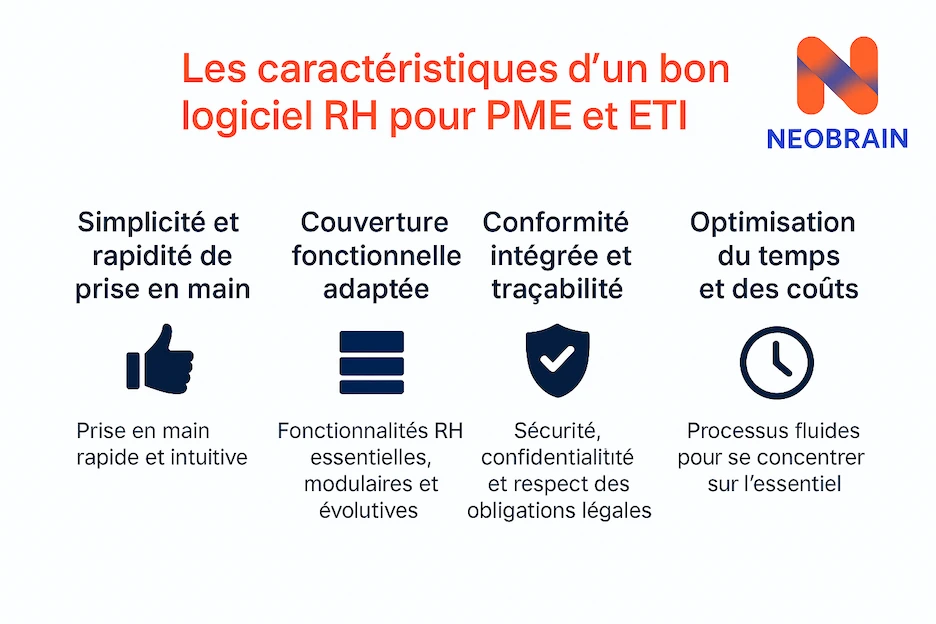
Simplicity and speed of handling
Ergonomics should allow everyone — HR, managers, employees — to use the solution without extensive training. In a context where every hour counts, the learning curve should be minimal.
Adapted functional coverage
SMEs and ETIs do not need the complexity of a comprehensive HRIS for large groups. The tool should focus on priorities: skills management, automation of interview campaigns, training monitoring and performance measurement, with the possibility of adding modules as the company grows.
Integrated compliance and traceability
The software should not only facilitate compliance with legal obligations, but also document each step, in order to provide evidence in case of control and to offer full transparency to stakeholders.
Optimization of time and costs
By automating repetitive tasks — absence management, reminders for interviews, consolidation of training plans — the tool frees up time for missions with higher added value and contributes directly to reducing operational costs.
What are the essential functionalities in HR software for SMEs/ETI?
Key features include: interview management, skills monitoring, training management, performance measurement, regulatory compliance, and automation of recurring tasks. Everything must be offered in an intuitive and flexible interface.
What are the advantages of using HR software to support essential processes
Going from manual or fragmented management to a complete HR software is not limited to gaining comfort: it is a real paradigm shift in the way in which the company manages its talents and anticipates its needs. Here are the major benefits that an SME or ETI can expect from it.
Centralized skills management
In many companies, information on skills is scattered between Excel sheets, obsolete job sheets and implicit knowledge held by a few managers. This fragmentation makes it difficult to anticipate future needs or identify internal talent.
HR software centralizes this data in a living and dynamic map, allowing HR and managers to quickly identify the skills available, those that are lacking, and the possible internal mobility gateways. This strategic management facilitates recruitment planning and optimizes career paths.
🔗 Learn more about skills management in SMEs
Monitoring and automating interview campaigns
Planning and monitoring evaluation campaigns or professional interviews can quickly become an administrative headache: multiple reminders, manual collection of forms, consolidation of results...
By automating every step — from scheduling to automatic reminders, including data aggregation — HR software drastically reduces the workload and ensures that each employee receives the same treatment. This allows managers to focus on qualitative analysis rather than logistics.
🔗 Read our guide to successful maintenance campaigns
Management of training
In a context where jobs are changing rapidly, it is essential to know where to invest the training budget. HR software makes it possible to collect and analyze the needs expressed by employees, to plan adapted sessions, to monitor registrations and participation, and to measure the impact of the actions taken.
This structured management avoids redundant training, maximizes the return on investment and ensures compliance with legal obligations.
🔗 Discover our methods for optimizing a training plan
Performance evaluation
Evaluation is no longer a fixed annual exercise. Successful businesses implement regular monitoring of goals, continuous feedback and personalized development plans.
HR software modernizes this process by offering shared monitoring tables, clear indicators, and performance histories, making it easier to recognize successes and identify areas for improvement.
🔗 Learn more about performance management
HR dashboards and analytics
HR data is a treasure... provided you know how to use it. With HR software equipped with analytics functionalities, it is possible to monitor key indicators in real time: turnover rate, skills progression, training participation rate, etc.
These dashboards help management and HR make informed decisions based on facts rather than impressions.
🔗 Discover the essential HR indicators
Where are you in your HR maturity?
Before comparing solutions and thinking about the selection criteria, it is useful to know where you are today in your HR digitalization. Assessing your maturity level allows you to identify your priorities and select software that will support you in your progress, rather than trying to do everything at once.
How do I assess my company's HR maturity?
Key evaluation criteria include:
- Structuring processes : do you have written and followed procedures?
- Digitalization : are your HR data and campaigns centralized in one tool?
- Strategic management : do you use your HR data to anticipate needs?
- Management culture : are your managers trained and involved in the process?
Our selection of the top 10 HR software solutions for SMB
Faced with the diversity of solutions available on the market, it is not always easy for an SME or an ETI to make the right choice. We have therefore selected 10 essential HR and HRIS software for you, which are particularly relevant for this business segment. We review and evaluate them according to key criteria: their ability to adapt to the specific needs of SMEs/ETIs, the quality of the support offered and their functional coverage.
Neobrain
What is it?
An all-in-one talent management SaaS suite, which places skills at the heart of your HR processes. Neobrain makes it possible to map, develop and mobilize talents thanks to a modular platform integrating: skills management, training, performance, interviews and internal mobility.
For whom?
Ideal for SMEs, ETIs and large accounts who want to manage all of their talents in a unified vision: career, performance, skills, training... Neobrain connects these dimensions and supports each organization in its evolution, leaving the freedom to activate its modules at its own pace.
Key points:
- Interconnected modules : skills, performance, training, interviews, mobility marketplace.
- Integrated AI : forecasting needs, real-time monitoring of differences, personalized recommendations and future AI agents (expected launch in October 2025).
- Strategic management : advanced HR dashboards, predictive scenarios and indicators aligned with business priorities.
- Optimized user experience : intuitive interface, rapid deployment, adaptation to SME/ETI specificities.
- Integrated compliance : regulatory management (professional interviews, training follow-up) and compliance with the RGPD.
365 Talents
What is it?
365Talents is a Talent Management SaaS platform which is based on theartificial intelligence and data analysis to create a dynamic skills map. The tool collects and merges internal data (CV, HRIS) and external data (LinkedIn, public profiles), making it possible to identify key skills, possible bridges between positions and future internal mobility needs.
For whom?
Designed for ETI and large groups who want to strengthen their internal attractiveness, manage talent mobility and anticipate needs through a data-driven model. Less suitable for very small structures without a mature data culture.
Key points:
- Smart mapping skills, automatically generated by AI.
- Internal mobility suggestions through the connection of available skills and opportunities.
- Seamless integration with more than 100 HR tools (SIRH, LMS, ATS...), thanks to a modern and connected architecture.
- Fast deployment : some customers see tangible results in a few months.
Alternative Neobrain or 365Talents?
Are you hesitating between 365Talents and Neobrain?” Here's an overview of the comparison based on public data and customer reviews on G2.
Skillup
What is it?
Skillup is a French HR software that brings together several modules related to talent management: training, annual/professional interviews, skills management (GEPP) and people review. The tool focuses on the digitization of these processes within a single interface.
For whom?
It is aimed at companies, SMEs or ETI, who wish to structure and formalize certain HR procedures, in particular on the training and skills monitoring components.
Key points
- Combines several HR functionalities withina single environment.
- Task automation such as reminders or the consolidation of interview data.
- Interface oriented to a simple use by HR teams and managers.
- Solution hosted in France, in compliance with the RGPD.
Neobrain or Skillup alternative?
You have heard about Neobrain and Skillup are you hesitating between the 2 solutions?” Here's a quick look at the comparison based on public data and customer reviews on G2.
Elevo
What is it?
Elevo is an HR software specialized in performance management and employee support. Initially focused on interviews and people reviews, the solution has gradually expanded its scope to include modules related to the definition of objectives, the management of feedback and more recently, the remuneration strategy.
Main features:
- Organization and follow-up of annual, professional and 360° interviews.
- People reviews to map the performance and potential of employees.
- Management of individual and collective goals.
- Assessment of skills as part of interviews.
- Compensation management module to structure salary campaigns.
Advantages highlighted by the publisher:
- Modern and intuitive interface, adapted to the uses of managers and HR teams.
- Customizing interview workflows and questionnaires
- Centralization of feedback and performance data in a single platform.
Alternative Neobrain or Elevo?
You now know Neobrain and Elevo, are you hesitating between the 2 solutions?” Here's an overview of the comparison based on public data and customer reviews on G2.
Factorial
What is it?
Factorial is an all-in-one HR solution that covers a broad spectrum of needs: payroll management, time and attendance tracking, personnel administration, talent management, absence management, and financial aspects such as expense management.
For whom?
The platform mainly targets SMEs and ETIs who are looking for a unique tool to centralize both administrative management and certain HR aspects. Although Factorial has a “talent management” module, the skills part remains limited compared to specialized solutions in this segment.
Key points
- Complete payroll management : automation of the calculation and generation of ballots.
- Time and attendance tracking : integration of schedules, absences and holidays.
- Administrative management : centralized employee files, HR documents.
- Add-on modules : expense reports, financial aspects and talent management.
Neobrain or Factorial alternative?
Neobrain or Factorial? Are you wondering which one will be the best ally for your HR challenges? We've analyzed public data and customer reviews on G2, CapTERRA to help you decide.
Empowill
What is it?
Empowill is a French HR software, founded in 2019 and based in Paris, which offers a SaaS platform dedicated to digitizing and managing the employee journey. The tool makes it possible to manage interviews, skills management, training follow-up and career planning, in a unique interface designed to simplify the daily life of HR teams, managers and employees.
For whom?
Empowill is mainly aimed at French SMEs and ETIs, all sectors combined (industry, construction, services, transport, etc.), who wish to structure, centralize and optimize their HR processes. The solution is intended to be easy to deploy and use, even in organizations that do not have numerous HR teams.
Key points:
- Interviews and evaluations : planning, monitoring and historization of the various types of interviews (annual, professional, mid-term...).
- Skills management : monitoring existing skills, identifying gaps and developing action plans.
- Training and development : centralization of needs, monitoring of training plans and traceability of actions carried out.
Zola
What is it?
Zola is a French HR software, created in 2021, which offers a complete and modular SaaS platform dedicated to the management of talents, skills and the digitalization of interviews and HR paths. Its vocation: to simplify and centralize HR rituals while adapting to the growth of French companies, in particular in the SME/ETI segment.
For whom?
Zola is mainly aimed at SMEs and ETIs, but also at SMEs and multi-site organizations from various sectors (catering, consulting, industry, services, etc.). The solution is designed for HR teams, managers and employees who want to manage skills, organize their interview campaigns and structure their HR development in a simple and customizable tool.
Key points:
- Organization and automation of interview campaigns with integrated reminders.
- Skills mapping to support GPEC.
- Feedback modules and internal surveys to monitor engagement.
Eurécia
What is it?
Eurécia is a French SIRH specialized in the administrative management of human resources. Its modules mainly cover time and activity management, holidays and absences, expense reports and, as required, payroll via partner integrations.
For whom?
The solution is primarily aimed at SMEs and ETIs who want to automate and simplify their daily administrative HR processes. Its approach allows HR departments to centralize requests and validations related to leave, schedules, or even expense reports, while ensuring regulatory follow-up. The tool focuses on operational efficiency and reducing time spent on repetitive tasks.
Key points:
- Time and absence management : comprehensive planning, validation and follow-up.
- Digitization of expense reports : simplified entry and quick validation.
- Intuitive interface : rapid adoption by employees and managers.
- A la carte modules : Activate only the required functionalities.
Phenom
What is it?
Phenom is a global talent experience management platform, designed to optimize the entire employee lifecycle — from recruitment to internal mobility, through engagement and career management.
For whom?
The solution is for businesses of all sizes, including large organizations, who are looking for a comprehensive tool to manage both talent acquisition and retention. Phenom focuses on the user experience, whether for candidates, recruiters, or existing employees.
Key points:
- Candidate Management : tools for sourcing, monitoring and engaging talent.
- Seamless user experience : interface designed to simplify navigation and interactions.
- Personalization : content and recommendations adapted to the profile of each user.
- Extensive functional coverage : recruitment, integration, internal mobility and employee commitment.
Talentia HCM
What is it?
Talentia HCM is a human resources and payroll management suite, covering both personnel administration, recruitment, time and activity management, training, as well as performance management. The tool is positioned in an intermediate segment, suitable for medium-sized companies and international organizations looking for a centralized solution.
Key features
- Administrative and payroll management (with badge integration and time tracking).
- Recruiting and onboarding employees.
- Training modules, skills management and performance monitoring.
- HR dashboards and reporting.
Advantages highlighted by the publisher
- Broad functional coverage (HR and payroll).
- Modularity to activate only the necessary modules.
- Ability to meet needs multi-country and multi-legislation.
Foederis
What is it?
Foederis is a modular HRIS solution that covers various aspects of HR management: recruitment, administrative management, skills monitoring, training, interviews, performance, performance, absence and compensation management. The platform works in SaaS mode, with secure hosting.
For whom?
Intended for companies of all sizes, including SMEs and ETIs, who want to structure their HR processes and have a single tool for several HR functions.
Key points:
- Propose a set of activatable modules according to the needs of the business.
- Allows you to centralize HR data varied for a more homogeneous follow-up.
- Integrates functionalities covering both administration and HR development.
- Solution available online, with update and maintenance provided by the publisher.
Lucca
What is it?
Lucca is a French HR software publisher, created more than 20 years ago, which offers a modular SaaS platform covering 14 tailor-made HR and administrative solutions. The objective: to digitize and simplify all HR processes, from personnel administration to talent management and daily activities. Today, more than 1 million users use its tools, in France and internationally.
For whom?
The solution is aimed at SMEs, ETIs and large companies that want to centralize their HR and administrative processes in a unique and evolving environment. Lucca is aimed at both HR teams, managers and employees, with a particular focus on user experience and ease of deployment.
Key points
- Complete administrative management: employee files, payroll, dematerialized forms.
- Management of absences and monitoring of working hours (GTA).
- Modules for interviews, performance, and skills development.
- Tools for measuring engagement and feedback.
- Expense management and multiple integrations with existing HRIS.
As an SME or ETI, how do you choose the right HR software?
Faced with an increasingly varied offer, selecting the right HR tool demand, method and foresight. The objective is to find a solution that meets your current needs while supporting the growth and future evolutions of your business.
1. Clarify your HR needs
Before reaching out to publishers, list your priorities precisely. Ask yourself the right questions:
- Do you first want to centralize administrative data (payroll, leave, expense reports) or manage talent (skills, internal mobility, performance)?
- Does your organization prioritize rapid deployment with essential modules, or complete functional coverage from the start?
- What are the problems to be resolved as a priority (loss of time, lack of visibility, monitoring of legal obligations, etc.)?
This clarification phase makes it possible to define a clear functional perimeter and to avoid unsuitable solutions.
2. Write a specification
The specifications are the road map for your project. It should detail:
- Strategic goals (reduction of turnover, improvement of productivity, regulatory monitoring...).
- Expected features classified by priority.
- The technical context (existing tools, ERP, payroll solutions, etc.).
- Budgetary and calendar constraints.
Precise specifications facilitate the comparison of offers and allows publishers to formulate a response adapted to your challenges.
3. Selection criteria
Beyond functionalities, several elements can make the difference:
- Ergonomics and ease of use : an intuitive tool promotes team buy-in.
- Integration capacity : compatibility with your existing software (payroll, ERP, CRM...).
- Rate model : subscription per user, annual package, additional costs (implementation, support).
- Support quality : responsiveness, availability, training resources and post-deployment support.
By combining these criteria, you maximize your chances of choosing HR software that integrates perfectly with your internal processes and supports your long-term HR strategy.
What steps should you follow to make the right choice?
How can teams be guaranteed to join?
HR software, even powerful, only keeps its promises if it is adopted by all employees. The success of the deployment is based on adapted support, clear communication and a tool designed for daily use.
👉 Discover our complete guide to promoting the adoption of HR software
1. Communication
Presenting the software as a tool at the service of teams, and not as a constraint, is essential.
- Explain the concrete benefits for each user profile (managers, employees, HR).
- Highlight time savings, process simplification, and easier access to information.
- Involve internal ambassadors to share their experience and encourage buy-in.
2. Intuitive interface
Clear design and smooth navigation reduce the learning curve and minimize resistance to change.
- Prioritize solutions offering ergonomics close to daily digital uses.
- Avoid overloaded screens and focus on simple, action-oriented paths.
- Make sure the software is accessible on all devices (desktop, mobile, tablet).
3. Employee experience
A well-designed HR software must contribute positively to the professional experience of users.
- Allow employees to manage their requests (leave, training, evaluations) independently.
- Integrate functionalities that promote the development of skills and the visibility of internal opportunities.
- Offer a consistent and personalized experience across roles.
4. Valorization of feedback
Gathering and exploiting user feedback is a powerful tool for improving adoption.
- Set up quick post-deployment surveys to identify areas of friction.
- Adapt the configuration or training according to the needs expressed.
- Show that feedback leads to tangible improvements, thus building trust in the tool.
What ROI can you expect from HR software?
Investing in HR software should not be seen as a cost, but as a direct driver of performance. The returns on investment are multiple: financial gains, increased productivity, better talent retention and improved compliance. Here are the main measurable levers, illustrated by data and concrete cases.
1. Reduction in turnover
A comprehensive HRIS reduces the turnover rate of 5 to 15% on average.
For an SME with 120 employees, this represents more than €41,000 in annual savings just on the costs associated with departures and replacements.
Knowing that the cost of a single departure varies between 50% and 200% of the annual salary, the financial impact is major.
💡 Customer case: Amicio has significantly reduced its turnover thanks to visibility on skills and internal careers.
2. Save time on HR campaigns
By centralizing and automating interview, mapping or training campaigns, HR software can help you win up to 800 hours per year, which is close to €25,000 in saved wage costs.
Administrative tasks can be reduced by 50%, thus freeing up teams for missions with higher added value.
💡 Customer case: Sogeclair has automated its interview campaigns, drastically reducing the time spent on managing them.
3. Strengthened compliance
Penalties for non-compliance with the GDPR can reach: 20 million euros or 4% of global turnover.
Traceable and secure HR software considerably reduces these risks, especially for sensitive employee data.
4. Optimization of the training budget
A good needs analysis makes it possible to target priority training courses and avoid redundant expenses. For SMEs, the training budget represents 0.55% to 1.6% of the annual payroll.
💡 Customer case: Sage identified 5 priority skills thanks to the self-assessment of 72% of its employees, thus optimizing its training budget.
5. Commitment and productivity
Companies with a high level of employee engagement show: +21% productivity according to Gallup.
💡 Customer case: BPCE has stimulated internal mobility and commitment through dynamic skills management.
Conclusion: choosing a partner, not just a tool
Beyond functionalities and comparisons, the choice of HR software is above all a human encounter. Opt for a partner you will enjoy working with: a team that makes you think, that provides relevant advice without questioning everything, and that helps you evolve your practices rather than simply modeling a tool on existing processes.
Take the time to make this choice: in some cases, involving future users in the exchanges — as we did with Sage and Neobrain — makes it possible to secure adoption from the start. This selection phase does not then prevent rapid deployment: on standardized processes such as annual interviews or talent reviews, the implementation can then be operational by 4 to 6 weeks.
Finally, choosing a partner today also means preparing for tomorrow. The arrival of AI agents will transform the way HR designs and animates the employee experience. Betting on a tool that opens up this perspective means laying the foundation for serene growth and assertive leadership on HR issues. Discover our vision of AI applied to HR.