

Introduction
Mid-Size Companies (ETI) are shaping the French economic fabric, combining ambition for growth and the need for agility. Between 250 and 4,999 employees, these structures navigate in a dense regulatory universe, where each threshold crossing leads to new HR obligations. For their human resources departments, the issue of compliance is not only a legal imperative: it is also a driver of internal structuring, talent retention and overall performance.
In this detailed overview, we draw up The mapping of the main HR obligations that structure the daily life of ETI's HR teams, distinguishing between what falls under Strict mandatory And what becomes Unmissable today to make the organization grow. Throughout the article, practical resources (guides, checklists, agreement templates) will be proposed to facilitate your compliance.

Define ETI and its compliance challenges
ETI include companies whose workforce is between 250 and 4,999 employees and whose turnover does not exceed 1.5 billion euros. This diversity of sizes implies contrasting operational realities: An ETI with 300 employees does not face the same regulatory challenges as a group of 2,000 or 4,000 people. However, as soon as a threshold is crossed, new rights and duties appear, especially in terms of social dialogue, training, professional equality or extra-financial reporting.
What are the priorities for ETI's HR teams?
HR in these organizations should focus their efforts on:
- Fine management of thresholds (anticipate future obligations),
- The centralization and automation of HR processes (avoid the all-manual approach that has become impossible on a large scale),
- The link between compliance, performance and employee commitment.
What are the main workforce thresholds that trigger new HR obligations for SMEs?
The key thresholds for SMEs are:
• 250 employees : Gender equality index, sexual harassment referent, strengthening of social dialogue
• 300 employees : Mandatory GEPP negotiation with the social partners
• 500+ employees : Progressive CSRD bonds by sector and turnover
• 1000+ employees : Strengthened extra-financial reporting and new CSR requirements
Each threshold crossing involves anticipating new obligations and adapting HR processes accordingly.
Detailed overview of HR obligations for midcaps
Occupational safety and health obligations
For SMEs with more than 250 employees, occupational health and safety compliance involves the appointment of a sexual harassment referent, strengthened health and safety policy requirements and increased attention to internal reporting.
For HR managers, it's about keeping documents up to date, training teams regularly and anticipating new risks. This rigorous management is essential to secure the organization while meeting the regulatory and social standards.
Legislation relating to social dialogue and staff representation
For SMEs with more than 250 employees, the social dialogue involves structured and regular management of the CSE, the animation of dedicated committees (health, education, equality) and the publication ofsocial indicators such as the gender equality index. The BDESE (Economic, Social and Environmental Database) is becoming essential for dialogue with staff representatives.
For HR directors, compliance is based on the rigorous updating of documents, training managers in social exchanges and the expectation of future consultations.
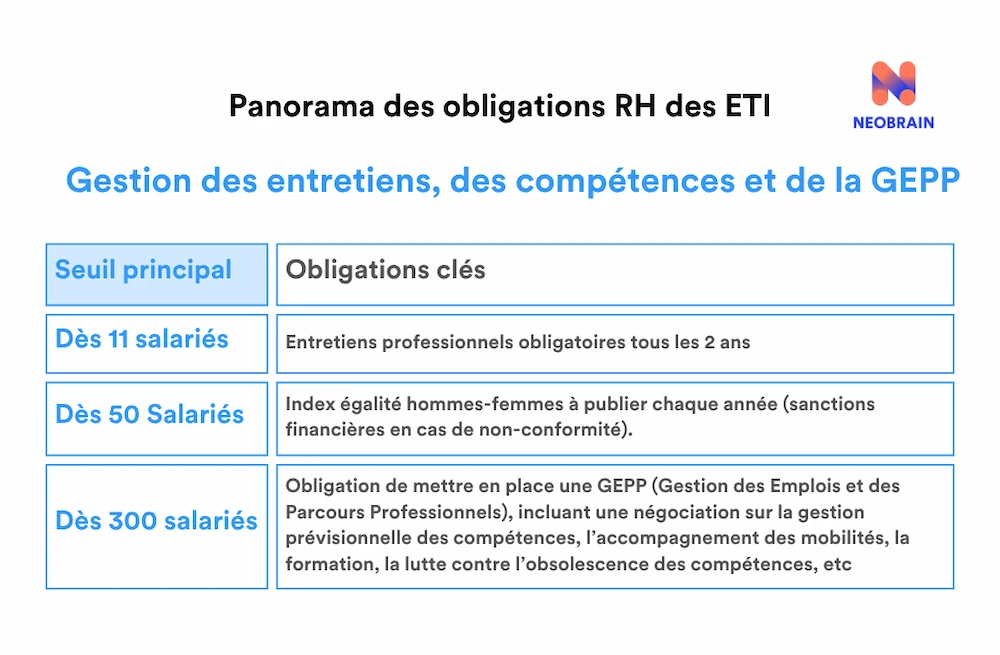
Regulation on the management of interviews, competencies and GEPP
For SMEs with more than 250 or 300 employees, the coordinated management of interviews, skills and GEPP (Job and Career Management) is becoming a strategic building block, both a factor of compliance and HR performance.
Professional and performance interviews
- Legal obligation : Professional interviews must be conducted every two years with each employee, systematically tracking the training, development or mobility actions proposed. Penalties may apply in case of non-compliance with the rules or the absence of a summary after 6 years.
- Performance interviews : Although not required by law, they are a recommended practice for setting goals, collecting feedback, and nurturing talent management. Their digitalization allows global management and homogeneity of treatment (see performance management).
- Business added value : Well-structured interview campaigns facilitate the detection of people at risk or with high potential, the proactive management of internal mobility and the feeding of GEPP.
GEPP (Job and Career Management)
- Obligation : From 300 employees, a GEPP negotiation is required — with the social partners — concerning the organization of jobs, support for the transformation of skills, the fight against obsolescence and the securing of career paths.
- Tool-based approach : Equipping the GEPP makes it possible to automate data collection, the crossing of projections (business, jobs, skills), the monitoring of action plans and individualized courses (see GEPP).
How to capitalize on interview and GEPP obligations for ETI HR teams?
Through these obligations, HR teams gain on 3 dimensions:
- Ensuring compliance by managing deadlines and obligations (interviews every 2 years, GEPP negotiation, reporting).
- Develop a managerial culture focused on identification, evaluation and the support of specific skills for SMEs.
- Industrialize these approaches through digitalization to gain in efficiency, traceability and ability to anticipate.

Legislation on professional equality, diversity and inclusion
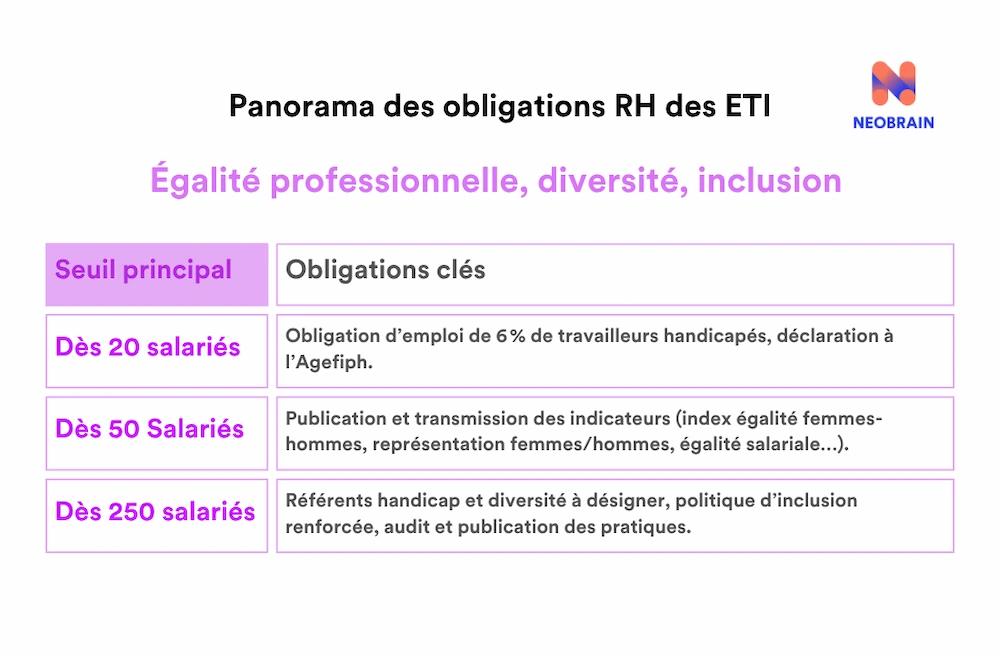
From 250 employees, it is imperative to publish annually The gender equality index, to designate a disability and diversity referent, and to justify a effective inclusion policy. The obligation to employ 6% of disabled workers applies from 20 employees, with reinforced controls beyond the upper thresholds.
For HR managers, ensuring compliance on these subjects involves regularly updating indicators, training teams, and anticipating legal or societal changes. This rigor is essential to minimize risks, strengthen the employer brand and support the attractiveness of ETI.
Legal requirements for social reporting and administrative compliance
These requirements are intensifying: the aim is to produce recurring statements (social report, DSN, single social report), to keep the BDESE up to date, and to prepare for more frequent checks (labour inspection, URSSAF). The reliability and timeliness of social data become an absolute priority: each oversight or delay can generate sanctions or call into question the credibility of the organization.
For HR directors, meeting these requirements requires a rigorous document management, the continuous training of HR teams, and the expectation of legal or sectoral changes to ensure flawless compliance.
.webp)
The mandatory dimensions of CSRD, CSR and “extra-financial”
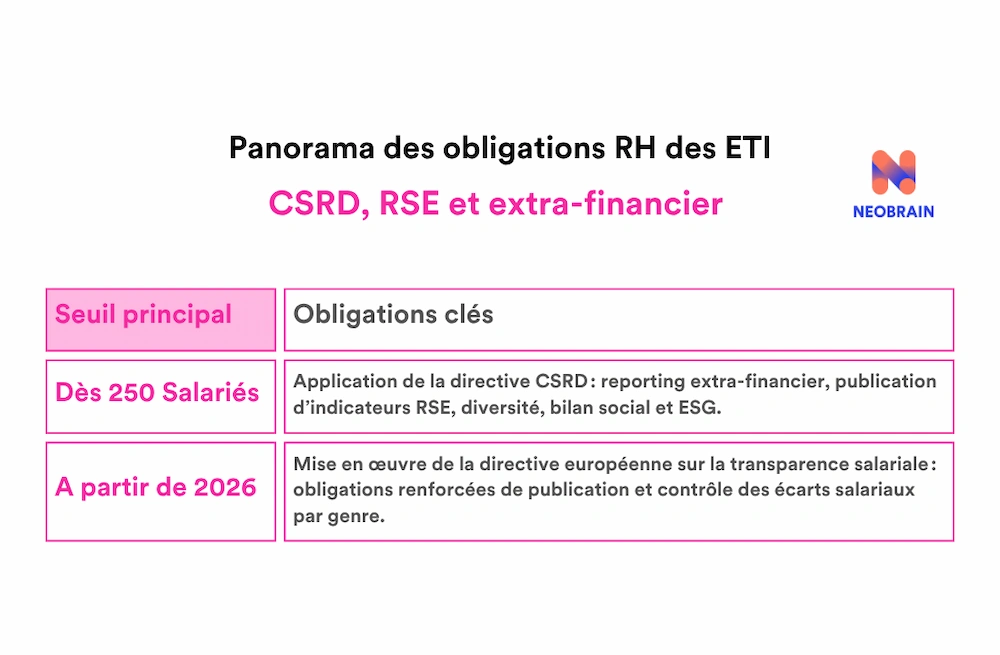
The CSRD regulation (Corporate Sustainability Reporting Directive) requires the annual publication of extra-financial reports detailed: CSR commitment, diversity, social balance sheet, environmental issues and ESG indicators.
In addition, for 2026, the necessary advance of the European directive on wage transparency, which will introduce new obligations to publish and monitor pay differentials.

For HR managers, it is essential to maintain alignment with European requirements, to ensure the reliability of the information shared and to train the teams in the expected transparency logic. This compliance guarantees the credibility of the ETI with stakeholders and reinforces social responsibility and the employer brand.
From regulatory to performance: combining compliance, business and digital tools
Compliance should not be experienced as a simple constraint: it becomes a real performance driver for SMEs. The automation of monitoring and the digitalization of bond management make it possible to:
- Secure your organization and avoid non-compliance,
- Better engage managers and employees by capitalizing on fluid and structuring processes,
- Free up HR time for subjects with higher added value: skills development, mobility, attractiveness.
ETI use case with Sage: managing GEPP and skills transformation
During a major transformation, Sage decided to equip its skills mapping with the Neobrain solution. See the Complete success story.
Objective: precisely identify current skills, anticipate those needed tomorrow, and then support all employees in this transition.
The approach was based on:
- A structured interview campaign (see performance management),
- The activation of GEPP (from 300 employees),
- The prioritization of training systems according to professions and needs
Results? 86% of employees covered in the map, increased internal mobility rate, increased managerial satisfaction.
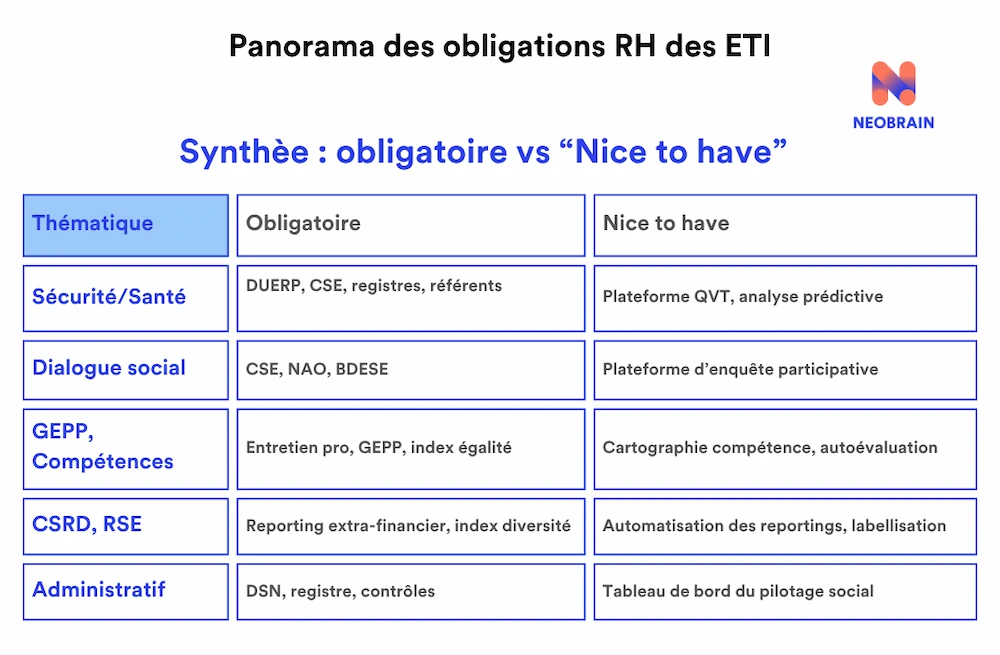
Pragmatic summary: separating “mandatory” and “differentiating”
At each stage, distinguish between:
- This is strictly a legal requirement and the absence of which exposes the ETI to immediate sanctions;
- “Nice to have”, differentiating approaches that allow us to go further: anticipate, structure, attract, retain.
Conclusion
Faced with the rise of regulatory requirements, SMEs must structure their HR compliance while maintaining their agility and capacity for innovation.
Equip bond management with software dedicated to ETIs, it is not only about securing the organization but also giving HR and management teams the means to strengthen commitment, attractiveness and performance.
Compliance thus becomes a driver, and not a constraint, for the sustainable development of SMEs.