
In many organizations, careers resemble hallways: you move straight ahead within your own department, without seeing the side passages to other roles. Making these passages visible is the entire purpose of career pathways.
A career pathway refers to the possible evolution path between a source role and a target role, based on the transferability of skills common to both positions. Identifying a pathway means spotting these shared skills and measuring the gap to be bridged to move from one to the other. We distinguish between short pathways, where the employee becomes operational after a few weeks of adaptation, and long pathways, which require more structured upskilling before taking on the role.
What is a career pathway? Definition and types
A career pathway is the evolution path that connects a source role to a target role, based on the skills that these two roles have in common. The core idea is simple: two positions that appear distant on an organizational chart often share a significant portion of their skill base. A customer account manager and a recruiter both utilize active listening, interview techniques, and needs qualification. Identifying these shared skills is the first step in mapping a pathway between the two.
Building a pathway is not about decreeing that one job "leads" to another. It is about objectifying what truly brings the two positions together, skill by skill, and then measuring the remaining gap. This gap is viewed in two ways: the skills already mastered and directly transferable on one side, and those that need to be acquired or developed on the other. The broader the common base, the shorter the pathway; the more numerous or technical the skills to be acquired, the longer it is.
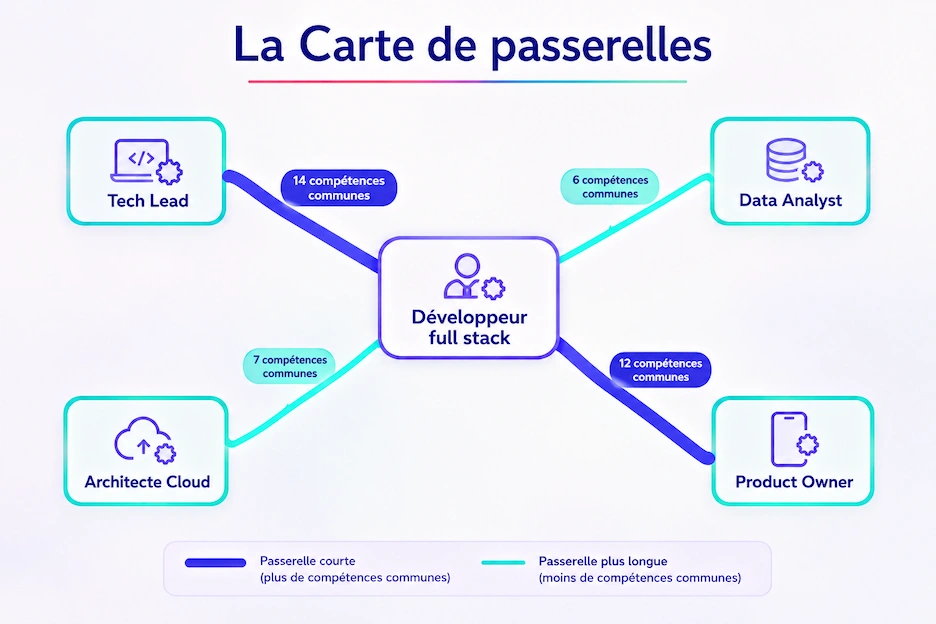
Above is an example with the role of developer as the source job and 4 pathway roles. The number of common skills largely defines the ease with which an employee will be able to migrate from one role to another. We will see that 4 other criteria can also be taken into account. We usually distinguish between two main types of pathways, depending on the size of the skill gap to be bridged.
The short pathway
In a short pathway, the employee already possesses most of the skills required by the target role. The transition only requires an adaptation period on the job, possibly supplemented by brief training upon taking the position. The employee becomes operational quickly, generally within a few weeks to a few months. This is the typical case of mobility between two roles within the same job family, where the core expertise remains identical and only the environment or tools change.
The long pathway
A long pathway implies a more significant skill gap, which cannot be bridged through practice alone. It requires a a true skill-building journey — a structured training program, often lasting several months and sometimes punctuated by intermediate roles — before the employee is fully operational in the target profession. This is the format for the most transformative transitions, those that move someone from one truly distinct profession to another, such as from a traditional technical role to an emerging field in data or AI.
Between these two benchmarks, the reality is obviously a continuum: each bridge has its own length, which depends on the employee's profile and their aptitude, as much as on the distance between the two professions. This is the whole point of being able to measure this gap rather than estimating it by intuition — a point we will return to with the concept of objectifying the transition effort.
Beyond skills: the other dimensions of a bridge
Reducing a bridge to a simple alignment of skills would be misleading, however. Two professions can share a large base of skills and still remain separated by a very real gap: that of the concrete conditions of practice. Beyond skills, a solid bridge must be examined on four complementary levels:
- Physical environment : office or field, indoors or outdoors, travel, on-site or remote work, industrial context, laboratory, or retail.
- Relational dynamics : individual or team work, frequency of interactions, client relations, cross-functional collaboration, managerial dimension.
- Organization and autonomy : decision-making scope, weight of instructions, position in the hierarchy, pace of work, standardized or exploratory tasks.
- Operational conditions : fixed or variable hours, night or weekend work, on-call duties, risk exposure, time pressure.
It is the intersection of all these levels — and not just skills — that determines the true length of a bridge. Two transitions showing the same proximity in skills may require very different support depending on whether or not they disrupt the employee's daily life. Hence the value of measuring this gap in all its dimensions rather than estimating it by intuition — a point we will return to.
Career bridge, internal mobility, retraining, workforce planning: stop the confusion

These four terms come up constantly in the same HR conversations, to the point of often being used interchangeably. However, they do not mean the same thing, and distinguishing between them greatly clarifies how internal career paths are managed. The simplest way to navigate them is to see them as four nested levels: the path, the movement, the tipping point, and the framework.
The career bridge is the path. It describes a possible route between two professions, regardless of whether someone is actually taking it. A bridge can exist on paper, mapped out and objectified, without having been traveled yet. It is a potential: it states that a journey is feasible, and at what cost in terms of skills.
Internal mobility is the movement. It is the act of an employee actually changing roles within the company—specifically by using one of these pathways. While a pathway is a map, internal mobility is the actual journey on that map. A single pathway can, in fact, be used by multiple employees at different times. This is the topic we explore in depth in our article dedicated to internal mobility, and this mobility can take various forms: vertical through promotion, but also horizontal or cross-functional, by changing jobs without changing levels—a career development logic that is no longer just about moving up a rung.
Retraining is the most significant turning point. The term is used when the transition is deep enough to truly change professions, often via a long-term pathway. In everyday language, retraining implies a radical change, sometimes outside the company; in an HR context, it primarily refers to the most transformative transitions, those that involve leaving one field for another. Every retraining process uses a pathway, but not all pathways lead to retraining: many facilitate much smoother transitions.
Finally, GPEC—now GEPP under the law—is the framework. Strategic workforce planning sets the strategic vision: which jobs will decline, which will emerge, and which skills need to be secured. It defines the "why" and the "where to." Pathways and internal mobility are the instruments that translate this vision into concrete trajectories. Without a GPEC approach, pathways lack strategic direction; without pathways, GPEC remains a document that is never deployed on the ground. The two need each other.
Keeping this hierarchy in mind—the framework (GPEC) sets the course, pathways map the routes, internal mobility follows them, and retraining identifies the most transformative ones—avoids many misunderstandings and, above all, helps determine which lever to pull depending on the objective.
How can you identify job pathways in your organization?
Identifying pathways on a case-by-case basis, using the intuition of an HR professional who knows their teams well, works for a few moves. But as soon as it comes to making all possible trajectories visible across an entire organization, intuition is no longer enough: you need a method. This method relies on three steps—starting with skills, identifying similarities, and measuring the gap.
Everything starts with skills, and therefore with a framework. As long as jobs are described by job titles and freely written job descriptions, no rigorous comparison is possible: two similar jobs may seem unrelated simply because they are described with different words. A skills framework provides a shared language that allows jobs to be compared on the same basis, skill by skill, rather than by job titles. It is the foundation without which nothing holds together.
Next comes identifying proximity. Once jobs are described in this common language, we can identify those that share a significant portion of their foundation—job pairs between which a transition is plausible. In addition to this skill proximity, we factor in the other dimensions mentioned above, such as environment, interpersonal requirements, autonomy, and working conditions, which refine the picture and rule out false positives: two jobs that look similar on paper but are separated by a radically different day-to-day reality.
What remains is to measure the gap. This is the step that most approaches leave vague, settling for a qualitative "close" or "distant." However, an HR professional who needs to decide between several career paths, estimate a training budget, or prioritize investments needs an objective benchmark. This is precisely the purpose of the SREI.
The SREI: Objectifying the reskilling effort
The SREI (Scaled Reskilling Effort Index) is an index that measures, as a percentage, the reskilling effort required to move from an origin job to a target job. A low score indicates a short transition, where most of the skills are already present; a high score indicates a long transition, requiring a significant upskilling journey. The benefit is that it transforms an impression—"these two jobs are quite similar"—into a value that can be compared from one transition to another. Below is a visual explanation of the SREI.
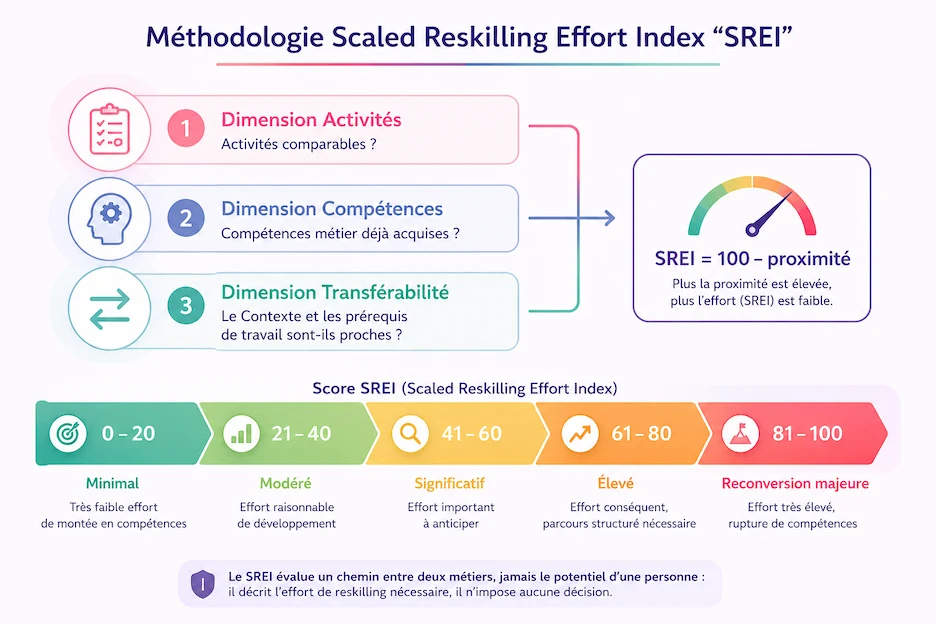
A few examples speak for themselves:
Starting from a developer position, the transition to a prompt engineer role shows an SREI of 21%: a short transition, as the technical foundation and work logic overlap significantly. Toward a data analyst position, the index rises to 32%: the transition remains accessible, but the gap to bridge widens. These scores, derived from a validated corpus, give HR a tangible basis for deciding where to invest and on what timeline.
We will not detail the entire mechanics of the index here—the reskilling levels, the construction of the corpus, or the weighting of dimensions beyond skills. This complete methodology, along with other examples of career paths and scores, is covered in our guide Hidden Capital: What Your Company Knows How to Do Without Realizing It, available for download at the end of this article.
What does a transition path look like? A concrete example
An SREI score indicates the effort required; it does not yet describe what the journey looks like. A transition, especially a long one, is almost never made in a single leap: it is traveled in stages, with each step helping to acquire a portion of the missing skills, often by leveraging intermediate roles that serve as stepping stones.
Let's look back at the transition from developer to prompt engineer. Its SREI of 21% makes it a short transition, and examining the other dimensions confirms this diagnosis:
- Identical physical environment : same workstation, same daily routine in front of the screen.
- Very similar relational dynamics : product team work, minimal disruption in interactions.
- Comparable organization and autonomy : project pace, similar decision-making leeway.
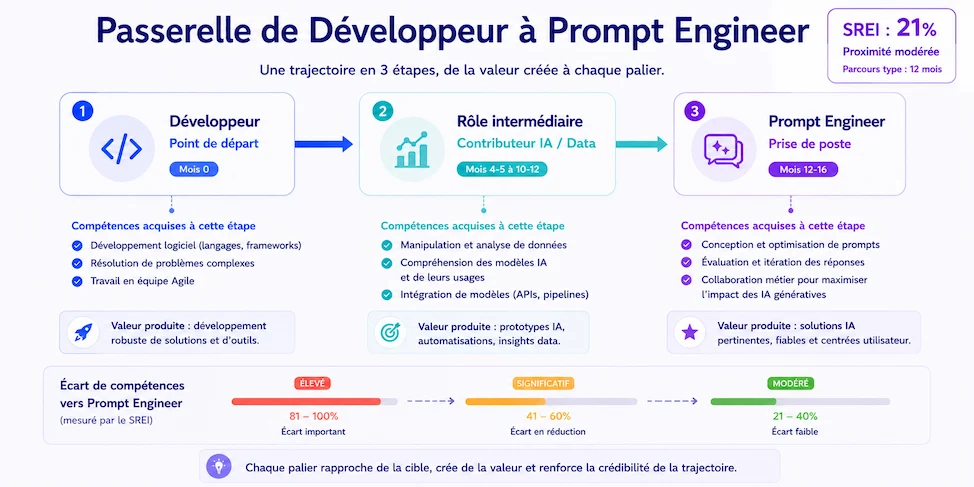
None of these plans extend the transition period. The effort is therefore focused almost entirely on new skills—prompt design and optimization, model output evaluation, and use case scoping—which explains why a trajectory of twelve to fifteen months is sufficient to complete it with confidence.
In practical terms, the developer begins by training in the fundamentals of language models while continuing their original duties. They then move through an intermediate role phase, working alongside data or AI teams, where they develop their evaluation and scoping skills in real-world situations. The final stage marks the transition into the new role, with a now-complete foundation. At each milestone, the remaining gap narrows and the value produced increases. An example of a bridge for the developer to prompt engineer role:
What career bridges change in practice
Structuring these bridges is not a theoretical exercise: organizations that commit to them reap measurable benefits, for both the company and its employees.
Tangible benefits, provided managers and employees are on board
For the company, the bridge reduces reliance on external recruitment : an open position can be filled by an existing employee who already knows the culture and processes, rather than through a long and uncertain hiring process. It also secures critical skills by anticipating roles in high demand. For employees, it opens up prospects beyond just vertical promotion and fosters engagement by showing that career growth is possible without leaving the company.
However, two often-overlooked stakeholders must be fully involved. First, managers: without their buy-in, the best bridges remain a dead letter, as it is up to them to let a talent move to another department and to welcome a profile in transition. Involving managers in mobility is a prerequisite for success, not a minor detail. Next, the employees: a bridge should be a choice, not something imposed. Giving everyone the means to visualize your own career paths turns mobility into a proactive choice rather than a top-down mandate.
Proof in practice: BPCE and Sogeclair
These benefits are more than just theory. Two organizations that have made their career pathways visible and actionable demonstrate their concrete impact.
BPCE — 60% of positions filled internally. By structuring its mobility policy around skills, the banking group now meets the majority of its needs using its existing talent. This figure shows that, even at scale, most roles can be filled without external recruitment, provided that internal pathways are clearly identified and accessible. Discover the BPCE case study
Sogeclair — mobility increased from 7% to 16% in one year. By making potential career paths visible to its employees, the company more than doubled its internal mobility rate in just one year. It proves that it is not enough for pathways to exist: it is their visibility that triggers movement. Discover the Sogeclair case study
In both cases, the common thread is the same: making pathways visible and actionable, rather than leaving them as dormant potential. This is how a company
From silos to bridges: revealing what your organization is already capable of
Rethinking careers as bridges rather than silos means changing how you view your organization. The skills needed to fill most roles are often already present within the company—scattered, underutilized, and invisible because they haven't been mapped. Career bridges are the tool that makes this capital visible and actionable: they transform dormant potential into concrete career paths, benefiting both the company and its employees.
The challenge, therefore, is not to create value from scratch, but to reveal the value that already exists. This requires three conditions: a common language to describe roles, a method to objectively measure the effort required to transition between roles, and the tools to deploy this mobility across the entire organization. This shift—from managing by job title to steering by skills—is what defines the Skills-Based Organization, where every available skill becomes a lever for mobility.