The temporal development zone (ZTD) is a concept resulting from the work of the human resources research team, led by Alain NGASSAM from the company Neobrain, on the time it takes for an individual to master a skill.
How do you define the Development Time Zone?
In the Littré dictionary, we define the verb” subdue ” such as “having a certain knowledge of something.” Mastering a skill therefore means implementing know-how (or interpersonal skills) with a sure knowledge of the subject, controlling its behavior or its progress.
Illustration of the Development Time Zone
Étienne, HR Manager at Pivoux, must bring five employees to a high level of function without compromising the requirements of the competency framework.
Some of the company's employees who had already been promoted pointed out to him that the coaching and training process seemed relatively long, that the learning curve was approximate and that, once established in the desired position, they could not quickly solve some of the complex problems inherent in the new job.
Étienne therefore wonders how to help employees quickly master skills that are peripheral (or related) to the job being performed in order to then give them the means to evolve into a peripheral profession (with the same professional dimension as the previous one).
Her colleague Catherine suggests that she start by asking the staff to position themselves on the core competencies. In this way, they will become aware of what they already know and what they are capable of doing. Also, Catherine explains that she adds parent skills to the job description of the people surveyed, notes the time it takes to master a new skill, as these people progress in implementing this skill to make an activity of a certain level of difficulty succeed. Étienne then feels strengthened in his desire to support employees towards a successful professional development by taking into account the Mastery time specific to each skill.
Why should we promote the use of the HR Development Time Zone?
- Optimize the training specifications: cost, duration, terms
- Adjust HR development strategies according to the progress of employees in their skills development.
- Improving agility in talent mobility
- Involve and empower employees in their professional development process.
- Gradually increase the level of requirement as you learn
The Development Time Zone should be included in the choice of objectives, supports and skill categories as shown in this visual of skills development. We are devoting a page to new opportunities for increase in skills.

Development Time Zone and Peripheral Skills
Our theory suggests that individuals gain mastery of a new skill more quickly depending on whether they come from a same rib.
The ZTD corresponds to the possible time for an individual to master a skill at a specific point in time. It is a realistic “control time” zone that draws its legitimacy from thousands of business experiences. This zone is certainly specific to each skill, but it is conceivable that a skill group also has its own ZTD. The more an individual advances in the ZTD of a skill, the more quickly he masters all the peripheral or related skills.
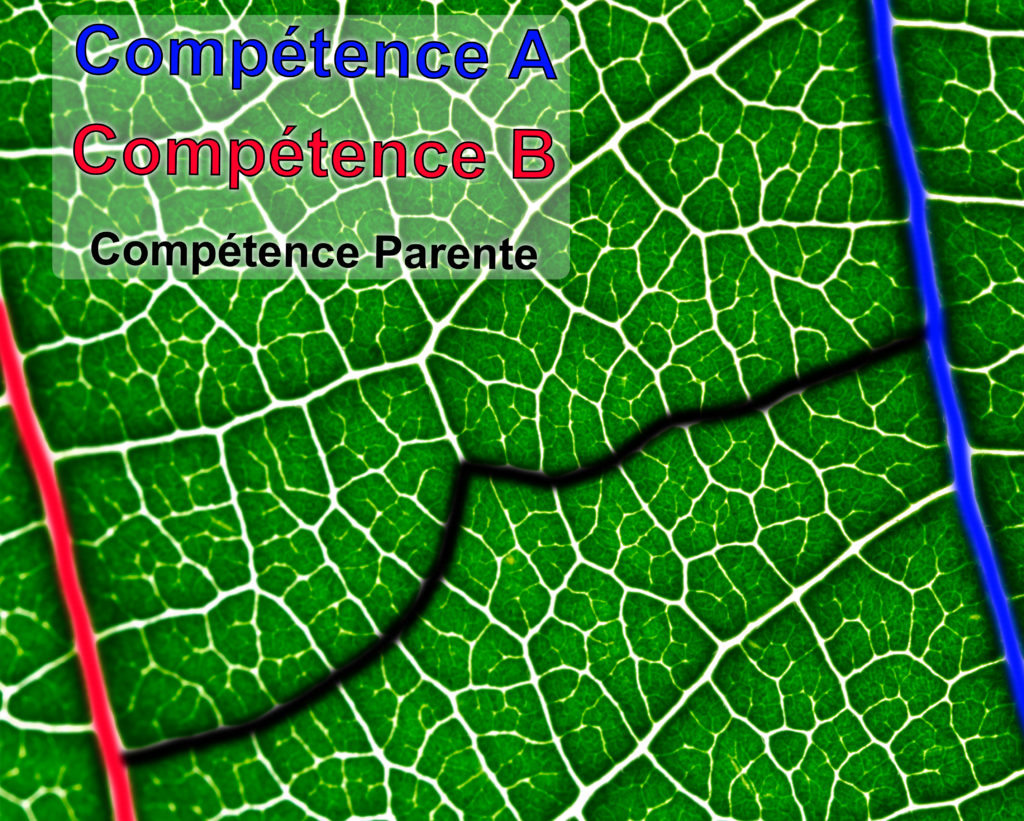
So it encourages learning through parent skills. The development time zone allows an individual to accelerate the time it takes to master the skills associated with those in their job description and therefore their potential to learn more quickly and more effectively.
The interest of this concept is to guide the work of HRM professionals on the one hand, and educational managers on the other hand, not only according to the achievements and past experiences of an individual, taking into account the functions occupied, but also and more in accordance with the future, by triggering the development of similar skills through more appropriate and better oriented learning.
The mastery of these parent skills goes hand in hand with the development of transversal skills in the company for reasons of versatility among employees. In times of major transformations, it is beneficial to have resources that can evolve from one role or task to another. Therefore, transversal skills are essential for mobility: our article”Transversal skills and mobilities“will allow you to consider this HR development option in detail.
Impacts of the ZTD in the role of the HR team
HRM professionals are responsible for training and maintaining each person in a ZTD. When an individual needs to master a skill whose level is below this zone, that skill is too easy to master and therefore does not evolve. Likewise, when an individual needs to master a skill whose level is beyond a ZTD, that skill is too difficult to master and leads the individual to failure. So it does not learn, it does not evolve. Taking into account the ZTD of a skill means facilitating access to jobs that are in short supply.
The progress of individuals is favored by a certain proximity of skills to each other.. Theoretically, this progression can be divided into different stages:
- Artificial Intelligence (AI) offers an A skill that is fairly easy to master without being too easy. Thus, it gives the individual an experience of success that increases his confidence in his ability to evolve into a new profession and to master skills of a certain level.
- AI offers a parent skill (skill B) that requires an increased level of mastery to evolve into the target profession and carry out one or more new activities (without these being too difficult). These new activities, on the other hand, require proportionate support.
- The AI measures the time required to master skill B, until the individual is autonomous in carrying out an augmented activity. This time includes:
- Explanations on the target activity,
- The integration of learning processes and strategies for correcting errors related to the new activity,
- Support for practice; - The AI assesses the end of the period of mastery of the parent skill (skill B), as soon as the individual no longer expresses a request for help. Thus, individuals validate their level of mastery of the parent skill, the time to master this skill, when they consider that they have succeeded in carrying out the augmented activity independently and with greater and greater ease.
- When the augmented activity becomes controllable by the individual, the AI proposes a new parent skill (competence C), which is more difficult (or not) and increases its assistance offer accordingly (e.g.: tailor-made continuing training, monitoring, coaching, e-learning, etc.). As a result, the ZTD of each skill is marked, thus making it possible to draw a learning curve towards activities relating to peripheral professions, activities that are increasingly open, varied, demanding, and thus opening up new possibilities for professional development and mobility, i.e. unsuspected career opportunities that were previously not visible or possible.
Artificial intelligence and the empowerment of course construction
Help is often primarily a form of heteronomy in the sense that the individual at work is dependent on it in order to succeed. But if, thanks to the power of AI, this help is provided in a perspective of empowerment, that is to say for the individual to draw up his own learning curve, with regard to his professional development project, he will integrate the support of AI by developing his own development strategies so that he will no longer need external physical help.
The intervention of AI therefore has the power of empowerment. It provides the necessary assistance for the development of skills without leaving HR professionals (or local managers) to carry out the progression paths in place of employees. In addition, AI contributes to making the autonomy of individuals a consequence of learning. In other words, AI helps individuals no longer need exclusive external support to build an adapted learning curve and career path.
Are you convinced of the value of giving employees the keys to build individualized paths? Find our Guide on the page”How can career plans be individualized?“