
You have structured your frame of reference. Maybe even mapped your jobs. And yet, something is resisting: positions that are struggling to be filled internally, training courses launched urgently, employees who leave for lack of visible prospects.
It's not a willpower problem. It's a debt problem.
Like technical debt in computer science — the debt that accumulates when structural projects are postponed —, the Debt skills forms silently. Each quarter without action, each gap not measured, each decision made by intuition rather than based on data: so many interests that are added.
The paradox? It is not visible in the accounts. But it is found everywhere else: in turnover, in deadlines, in the growing dependence on external recruitment. Above all, it is growing—while the organization mistakenly thinks that it spent nothing.
This article dissects what this inaction really costs, how debt is formed, and why acting now is always cheaper than waiting.
What is skills debt?
Skills debt refers to the accumulation of untreated gaps over time — and like any debt, it produces interest.
Everyone knows the Skills Gap — this gap between the skills available in the organization and those that it needs. It is an observation. An inventory of the situation.
La Debt skills, it's something else. This is what happens when this gap is not treated in time. When it is seen but not measured. Measured, but not addressed. Addressed punctually, but never structurally.
Exactly like financial debt, it follows a logic of compound interest: the longer you wait, the higher the repayment cost. One critical competence undeveloped today, it is an expensive external recruitment in six months, or a strategic project slowed down in a year.
What makes it particularly insidious is its accounting invisibility. It does not appear in the balance sheet or in the HR budget. It dissolves into other indicators — turnover, absenteeism, delivery times — which are each treated separately, without ever relating the symptoms to their common cause.
How does it form — and why is it invisible?
Skills debt doesn't happen overnight. It takes place gradually, using three mechanisms that reinforce each other.
- Obsolescence not detected. Jobs evolve more quickly than standards. A skill that was critical three years ago may already be partially outdated — but if no one updates Cartography, the gap is growing without anyone seeing it. It's not a lack of data: it's a lack of data Alive.
- Growth without internal development. When activity accelerates, the natural reflex is external recruitment. Faster, more visible, easier to justify in committee. But every recruitment that could have been a internal mobility is a missed opportunity — and a signal that debt continues to accumulate silently.
- Unanticipated turnover. Employees who leave don't just do it for a higher salary. In the majority of cases, it is the absence of development prospects that triggers the decision. And when they leave, they take with them skills that the organization has never formalized or transmitted.
What makes these three mechanisms so difficult to counter is that they remain Out of HR decision process. Until competencies are integrated into interviews, training plans, or mobility trade-offs, they remain a parallel subject — consulted, but not activated.
How much does it really cost?
This is the question that finance departments ask HR — and one that is difficult to answer precisely, precisely because skills debt is not on any line. However, the costs are there. They are divided into four distinct positions.
Avoidable external recruitments. When competence is not detected internally, external recruitment is carried out. Unsuccessful or unanticipated recruitment costs between 6 and 9 months' salary depending on the function. And in the majority of cases, the profile sought existed — or could be developed — internally.
Training courses initiated in an emergency. Planned training costs on average 30 to 40% cheaper than reactive training. When the need is identified too late — during a project, a regulation or a departure —, deadlines are reduced, costs increase, and educational effectiveness decreases.
Turnover linked to the absence of prospects. Replacing an employee costs between 50% and 200% of his annual salary (Gallup). However, the lack of visibility on possible developments is one of the first causes of voluntary departure. Each unanticipated departure is a lost skill, a replacement cost, and often external recruitment that is added to the debt.
Productivity degraded silently. It's the hardest cost to quantify — and the most underestimated. Employees who work with partially obsolete skills, managers who make up for the shortcomings of their team, projects that progress at a slow pace: all diffuse losses that are not displayed anywhere, but weigh on overall performance.
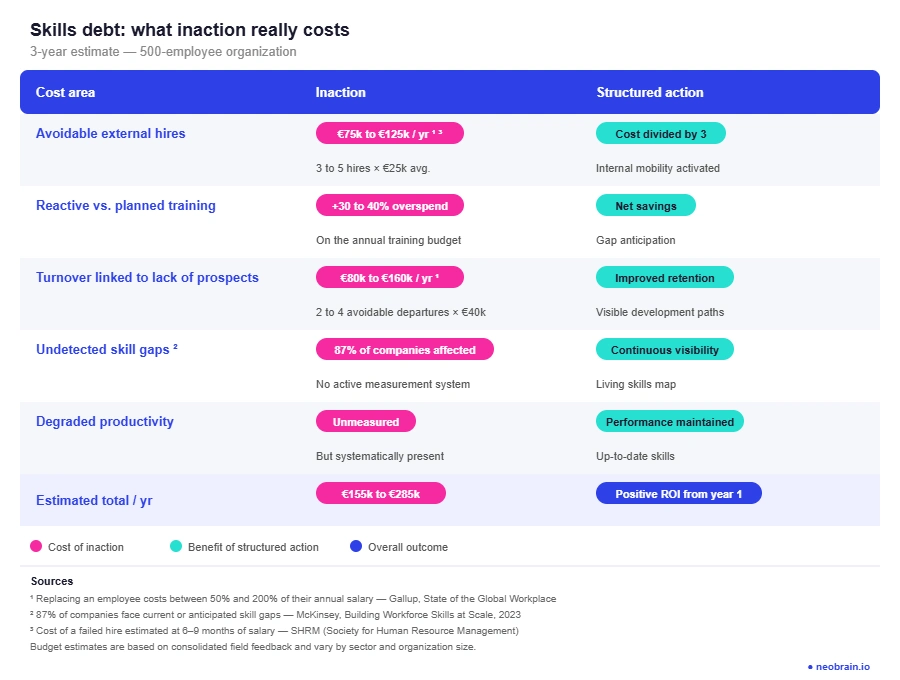
These numbers are not theoretical projections. These are costs that most organizations already bear — without seeing them, and without connecting them to their cause.
How do I measure skills debt in my organization?
Three indicators make it possible to estimate it: the rate of external recruitment for positions that could have been filled internally, the additional cost of training courses initiated urgently compared to planned training, and the turnover linked to the absence of development prospects declared during the initial interview.
Three levers to start paying off debt
Stopping the accumulation of skills debt does not require a major transformation program. It starts with three concrete decisions — which have in common Make visible what was invisible.
Move from annual training to ongoing upskilling. One-off training, triggered once a year on the basis of a plan built in the chamber, is precisely what feeds the debt. It's not the training that's the problem — it's the pace. A continuous upskilling system, rooted in the real differences measured on skills data, reduces the cost of each development action and improves its effectiveness. The right training, at the right time, for the right person — not a catalog open to everyone.
Transform manager exchanges into weak signal sensors. Managers are the first to detect that an employee is flat, that a skill is lacking, that a position evolves faster than its incumbent. But without a structured framework, this information remains in the manager's head — it does not feed into the mapping, training plan, or mobility decisions. Regular exchanges, equipped and connected to HR data, transform each conversation into an update of the living repository.
Make skills data a dashboard, not an archive. Most organizations have data skills — they just don't use it to make decisions. An active dashboard doesn't just measure what's out there: it shows what's missing, what's eroding, what's becoming critical. It's the difference between a photograph and an alert system.
These three levers are not new. What is new is to connect them together — and to connect them to reliable, living and shared skills data between HR and managers.
Conclusion
The special thing about skills debt is that it does not generate any alerts. No red line in the budget, no notification in the HRIS, no crisis meeting. It builds up silently — and that's exactly what makes it expensive.
What we saw in this article confirms it: organizations don't choose to go into debt. They just don't choose to take action. And the absence of a decision is itself a decision — the cost of which is not neutral.
The good news: unlike financial debt, skills debt is repaid quickly as soon as it is made visible. A living framework, managers equipped to detect weak signals, skills data integrated into HR decisions — three levers are enough to reverse the dynamic.
So the question is not “do we have the means to act?” It is: “can we still afford not to?”