

A quick clarification: when you type this query into a search engine or ask an AI assistant, two topics coexist. Using AI to build a skills map, or mapping AI-related skills within the company. These are two distinct topics. This article addresses the former.
If you're looking to understand why skills mapping is a strategic challenge, our dedicated article sets the stage. Here, we dive directly into the how.
The real problem isn't where you're looking for it
Most organizations already possess the necessary data to build a comprehensive skills map. Job histories, role transitions, training completed, certifications, organizational structures: all of this has been dormant in the HRIS for years.
On paper, that should be enough. In reality, it's never enough.
Because the problem isn't a lack of data. It's a lack of visibility into skills.
And this problem intensifies as soon as we focus on the populations that matter most and are seen the least: frontline employees, technicians, industrial site operators. They don't regularly log into the HRIS. They don't complete self-assessments. They often only have a single annual review. The result: their real skills are absent from the skills map — or so poorly represented that they are useless.
This is precisely where AI changes the game. Not by replacing HR teams, but by giving them an analytical capability that manual methods structurally cannot achieve.
The starting point: activate, not collect
The natural reflex when faced with a skills mapping project is to want to rebuild everything. Launch a major data collection campaign. Mobilize managers. Organize workshops.
This is often unnecessary — and sometimes counterproductive.
An HRIS like ADP or Oracle Cloud HCM already contains years of structured HR data. AI can read, cross-reference, and structure this data to produce an initial skills baseline — without starting from scratch. This is called activating existing data. And it's a much stronger starting point than a blank slate. To learn more about what building a skills framework entails, our practical guide details the steps.
The five steps to AI-powered skills mapping
1. Structure and clean data
Before any analysis, there's a fundamental task that no one likes to do and everyone underestimates: cleaning. Here are some examples of changes to make following an audit:
- Identify duplicate job titles or imbalances in the number of skills across multiple jobs
- Correct skill formalization, avoid overly granular skills
- Investigate the relevance of orphaned skills
- Harmonize labels across entities or geographies.
- Detect inconsistencies in career histories.
AI performs an initial investigation in a few hours to empower HR teams to reflect and make corrections. Manually, these activities can take weeks — if these flaws even surface. Yet, this step determines the reliability of everything that follows. A skills map built on poorly structured data remains unusable.
2. Generate an initial skill base for each job role
Based on structured data, AI automatically suggests skills associated with each job role or job family. It relies on semantic analysis of what employees have done, what they have learned, the contexts in which they have evolved, the industry sector, and an understanding of the transformation challenges experienced.
This is not a final deliverable. It's a working foundation. It requires human validation — which is the next step.
3. Define proficiency levels: the step that cannot be bypassed
A skills map without proficiency levels is just a directory. Not a decision-making tool.
To know if an employee can move to another position, if they pose a critical risk if they leave, or if training is needed, you need to know their actual level for each skill. Not just their presence in a repository.
This step is fundamentally human. It involves employee self-assessment and managerial validation. AI facilitates the collection and processing of this data. It does not replace judgment.
This step also determines the quality of everything that follows: without reliable levels, it's impossible to identify realistic career paths, relevant risk areas, or actionable gaps.
4. Validate and refine in asynchronous collaborative mode
This is where Lexi, Neobrain's AI agent dedicated to skill repository management. Its main value doesn't lie in isolated analytical capability. It lies in the fact that it centralize the entire project on a single platform — allowing HR teams, managers, and subject matter experts to collaborate without needing to meet.
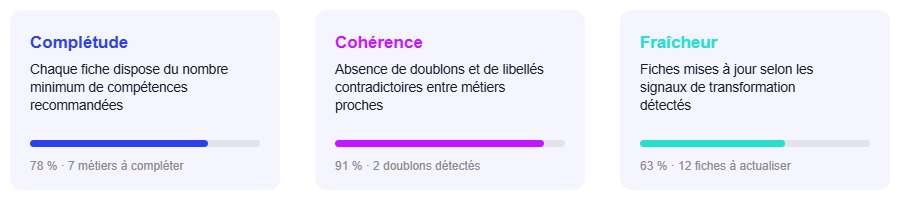
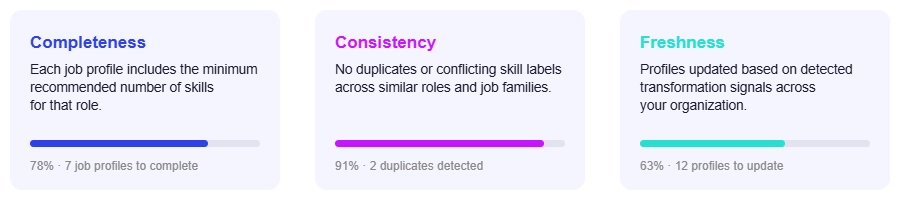
Specifically: Lexi submits skill proposals to the right people, collects their feedback, and consolidates decisions. It also continuously measures the quality of the repository based on three indicators we've learned not to overlook:
- Completeness. Each profile has the minimum recommended number of skills. No empty profiles.
- Consistency. No duplicates, no contradictory labels between similar roles. What seems obvious is never so at scale.
- Freshness. Profiles are updated based on detected transformation signals, not according to the next annual campaign schedule.
This continuous governance model is what differentiates a living repository from a static document. To understand the full scope of Neobrain's AI capabilities, our dedicated HR artificial intelligence page provides a comprehensive overview.
5. Keeping the Repository Alive Over Time
A repository built once and never updated is a liability, not an asset.
Roles evolve. New skills emerge. Positions transform or disappear. Without an update mechanism, the mapping becomes obsolete in a few months — and with it, all HR decisions that depend on it.
Lexi monitors transformation signals — industry changes, new certifications, reorganizations — and alerts when a profile needs revision. It's no longer an annual campaign; it's continuous governance.
What the Mapping Reveals Once Built
A well-constructed mapping doesn't just answer HR questions; it raises new ones — and answers them immediately.
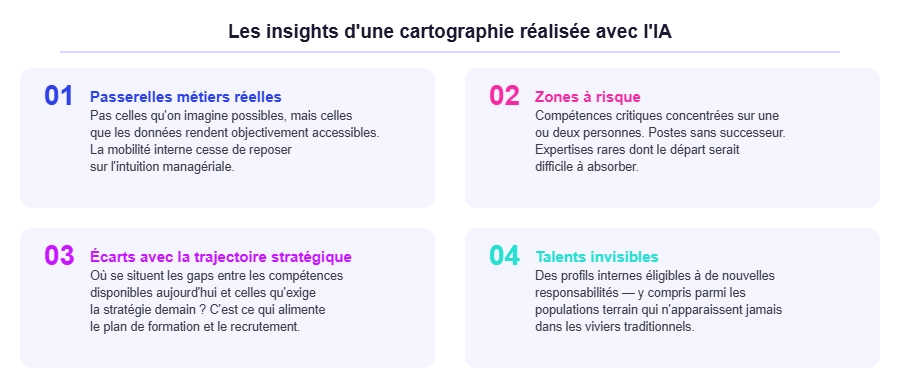
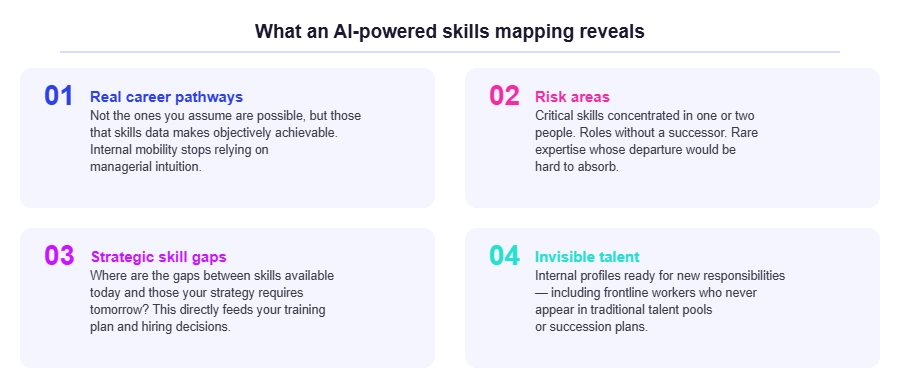
- Real career paths. Not the ones we imagine are possible, but those that skill data objectively makes accessible. Internal mobility no longer relies on managerial intuition.
- Risk areas. Critical skills concentrated in one or two individuals. Positions without an identified successor. Rare expertise whose departure would be difficult to absorb.
- Gaps with the strategic trajectory. Where are the gaps between the skills available today and those required by tomorrow's strategy? This informs the training plan and recruitment policy.
- Invisible talents. Internal profiles eligible for new responsibilities — including field staff who never appear in traditional talent pools.
These deliverables are directly usable in succession reviews, workforce planning committees, and GEPP meetings. Regarding the connection between mapping and workforce and career management, our article dedicated to GEPP explains the link.
Choosing the right tool: what separates a promise from a solution
The skills management tool market is crowded. To navigate it, a few criteria help distinguish what works from what merely promises to. Our page dedicated to skills management presents the key capabilities to evaluate in this type of project.
- Native integration with existing HRIS. The tool must read and structure data from Workday, SAP, Cegid, or any other HRIS — without a six-month integration project.
- Coverage of field staff. The solution must map the skills of employees who rarely connect to HR tools, without relying on their active participation.
- Integrated collaborative validation. An asynchronous workflow avoids email back-and-forth and ensures the involvement of business teams without constantly mobilizing them.
- Automatically measured quality indicators. Completeness, consistency, freshness: these three signals must be continuously calculated, not manually estimated once a year.
- Continuous governance, not ad-hoc. The tool alerts you if something becomes obsolete. It doesn't wait for you.
Lexi, Neobrain's AI agent, was designed to meet these five criteria — with particular attention to complex environments: multi-site, mixed populations, and large workforces. Discover how Lexi supports your mapping project →