Identifying and defining an organization's professional skill categories ensures clarity and performance for all employees and freelancers.
The evolving landscape of professions and industries highlights the importance of emerging skills, which offer mutual benefits to companies and employees. Aspects such as remote work, proficiency with digital tools, and a focus on sustainability necessitate continuous training and the acquisition of new knowledge.
To prevent an excessive proliferation of business skills listed within the organization, which could undermine the effectiveness of skill management, it is advisable to utilize a typology of skills that is formally structured and maintained in a repository.
How to categorize skills?
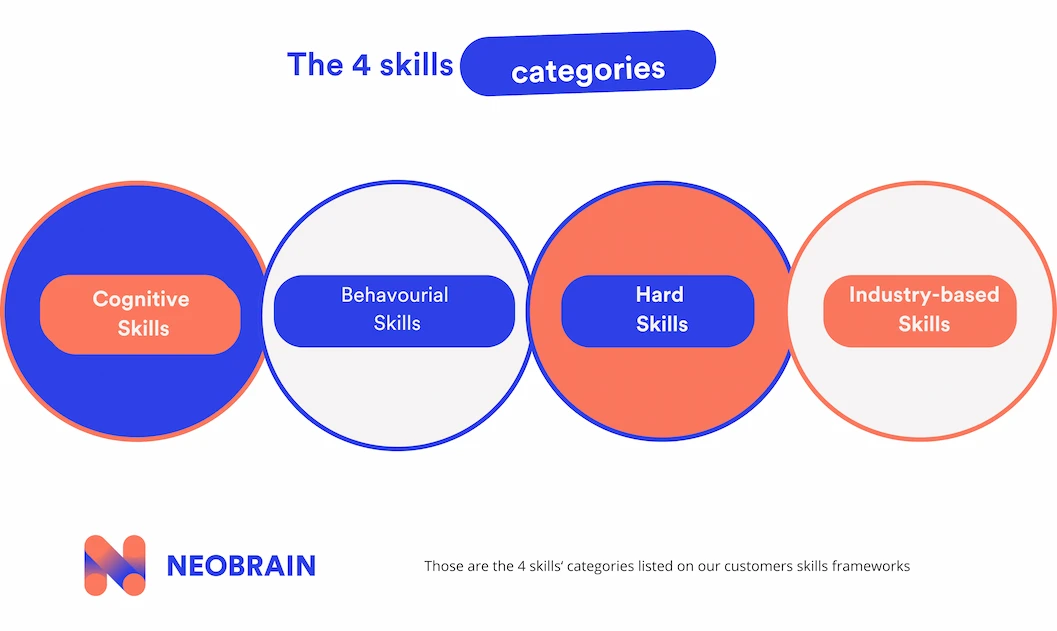
We distinguish 4 categories of skills:
- cognitive skills = Mental and intellectual abilities
- behavioral skills = Attitudes and social interactions
- technical skills = Practical skills and specific tools
- sector skills = Expertise specific to a sector
Cognitive skills
How do you define a cognitive skill?
Cognitive skills are cultivated through the mental processes of gathering and processing information to accomplish a task. They are the fundamental abilities that the human brain employs for thinking, learning, remembering, reasoning, and paying attention to various external stimuli.
These skills are essential for tasks as basic as walking or reading, as well as for more complex activities such as solving mathematical equations.
They also enable us to make decisions based on previously acquired knowledge stored in our memory. They also function based on past experiences.
When discussing this classification of cognitive abilities, we are referring to memory, attention, perception, logical thinking, and speed of thought. It is important to note that these skills begin developing during early childhood.
In the workplace, cognitive skills can manifest in various ways, depending on the nature of the job or the activity at hand.
Illustration:
For someone working in the restaurant industry, cognitive skills may involve performing quick, problem-solving and efficient actions. On the other hand, for an architect, cognitive skills might center on logical thinking to create precise and feasible designs.
Behavioral skills or "soft skills"
How do you define behavioral skills?
Behavioral skills are those that cannot be acquired solely through formal education or training (no school can teach behavioral skills). They encompass personal and interpersonal skills. Activities such as extracurricular pursuits, sports, volunteer work, and general life experiences are likely to contribute to the development of these skills. Often not readily observable, behavioral skills require detection either through the use of tools or, more commonly, through the attentive and curious support of managers and HR personnel.
This type of skill can be applied to various situations, both personal and professional, and across different sectors of activity. The term commonly used to describe these behavioral skills in many contexts is “transversality.” Specifically, we have explored three trends in the business landscape:
Here are a few examples of behavioral skills:
- Active listening
- Persuasion
- Creativity and idea generation
- Taking initiative
- Organization and planning
- Stress management
- Kindness toward others
- Transportation

Illustration of the different types of skills:
For a salesperson, key business skills include the ability to persuade customers, negotiate, and effectively manage stress in various situations. These skills are essential for closing deals and hitting sales targets.
These skills are becoming increasingly important in the professional world. They help foster harmonious collaboration, boost productivity, make work feel more natural, and ultimately lead to greater fulfillment in business or company management.
While they complement other abilities, behavioral skills are highly valued by most managers and can significantly improve your chances of landing a job.
According to the BLS (Bureau of Labor Statistics), 60% of the capabilities required to perform a job are related to soft skills.
A variation of soft skills known as "Mad Skills" emerged less than five years ago and gained prominence during the Covid-19 pandemic. A Mad Skill is an extraordinary ability developed outside the professional sphere that allows individuals to draw connections between seemingly unrelated fields.
For example, an actor with improvisation skills can engage in quick, dynamic conversations with clients or colleagues. Companies actively seek these skills because they provide the adaptability that is particularly valuable in today’s uncertain times.
How do you assess these abilities? We attempt to answer this question on the“Talent assessment and progression” page.
Technical skills or "hard skills"
How do you define a technical skill?
Technical skills are trade-specific. They require training to acquire and encompass both theoretical knowledge and practical expertise. These skills can be validated through diplomas, certifications, and professional experience.
In this context, a wide range of skills is deployed to suit a specific profession. These skills also evolve rapidly and can become outdated sooner than expected, making them a primary focus for HR development investments.
Illustration:
For instance, examples of technical skills include preparing balance sheets for accountants, developing marketing strategies for marketing managers, proficiently using software for HR professionals, managing projects for managers, and following specific methodologies or procedures for technicians.
Unlike behavioral skills, technical skills are more easily identified and can be measured using technical tests.
Industry-specific skills
How do you define industry-specific skills?
Sector-based skills pertain to qualifications and knowledge specific to a particular industry or field. In essence, possessing sectoral skills demonstrates a thorough understanding of the sector’s challenges and culture.
Certain knowledge is industry-specific and closely tied to particular sectors of activity, such as:
- Technology
- Banking / Insurance
- Construction
- Legal services
- The nuclear industry
- The pharmaceutical industry
- Transport
Illustration:
For a full-stack web developer, their skill set may include familiarity with specific regulations in the healthcare sector or an understanding of its culture. This enables them to effectively communicate and collaborate with peers in the workplace or on related projects.
In many cases, sector-specific skills are acquired through specialized training programs, such as obtaining a Master’s degree in Nuclear Engineering. However, they can also be acquired on the job, particularly in cases of career transition, like an accountant transitioning to a Data Analyst role. Each sector possesses its own distinct vocabulary, challenges and unique culture.
Conclusion
In conclusion, skills are intangible concepts that companies aim to operationalize by defining their requirements and identifying their assets.
Whether technical, sector-specific, behavioral, or cognitive, these skills are manifested within a specific context. This context is crucial not only for recruiting the appropriate individuals but also for engaging motivated talent who are aware of the environmental factors influencing their work.
In the world of work, all categories have their place and need to be developed throughout an individual’s career. Some of them may be cross-disciplinary to various professions and business sectors, and are the common denominators of internal mobility. To help you create mobility more easily from skills, you can take inspiration from our article: “Cross-functional skills and internal mobility”.
By utilizing this categorization, HR professionals and managers can enhance the management of corporate and human resources by emphasizing the alignment between the organization’s requirements or goals and its pool of available assets.