The pace of business change is something employees are acutely aware of. In fact, 67% of them feel that this evolution is happening too fast. Employees are therefore aiming to maintain their employability on one hand, and to broaden their skill sets into new areas on the other. For the company, this adaptation is also critical to its long-term viability. Yet, a skills mismatch persists, as evidenced by the 373,100 positions that remained vacant at the start of 2023. How can we align skill development with company needs?
The challenges of skill development
Implementing a policy to enhance skills is a key challenge of Strategic Workforce Planning. Establishing a system that encourages skill development presents human, organizational, and economic challenges. What are the stakes?
- Detecting shifts in professions and emerging skills
- Adapt to changes in the environment and maintain company performance over the long term.
- Find the right balance between mandating skill acquisition and empowering employees.
- Measure progress in skill levels reliably.
In terms of resources, this approach makes it possible to retain key talent and facilitate internal mobility. It is also an opportunity to maintain individual adaptability to potential economic shifts, as we observed during the job market changes caused by Covid-19, when nearly 20% of employees had to change their roles.
Here is an additional source of information for identifying skills to develop:“How to identify skill needs?”
Anchor skill development in Workforce Planning
Medium-term job and skill planning is managed through Workforce Planning (GPEC). This mechanism has replaced Strategic Workforce Planning since 2017. It is a tool that, among other things, involves investing in employee employability so they can meet the company's strategic objectives.
Workforce Planning also aims to identify career paths and profiles that align with the requirements of a position during an internal HR reorganization.
We explain the differences between Strategic Workforce Planning and Workforce Planning on our page“Workforce Planning replaces Strategic Workforce Planning”.
Identify the categories of skills to be developed
In management, the term "skill" is a rather broad concept. Before approaching skill development, it is necessary to distinguish between individual and collective skills, as well as to differentiate between technical, behavioral, cognitive, and industry-specific skills. Thus, depending on your objective, you as a manager can facilitate support for your employees based on the type of skills being developed.
Since most activities are carried out in teams, skill versatility is a key criterion for assigning employees to projects. Today, talent favors an operational approach to their own development: the kinesthetic dimension is the most widespread learning lever, alongside auditory and visual methods. We therefore recommend increasing skill levels by integrating them into the missions employees carry out as a team.
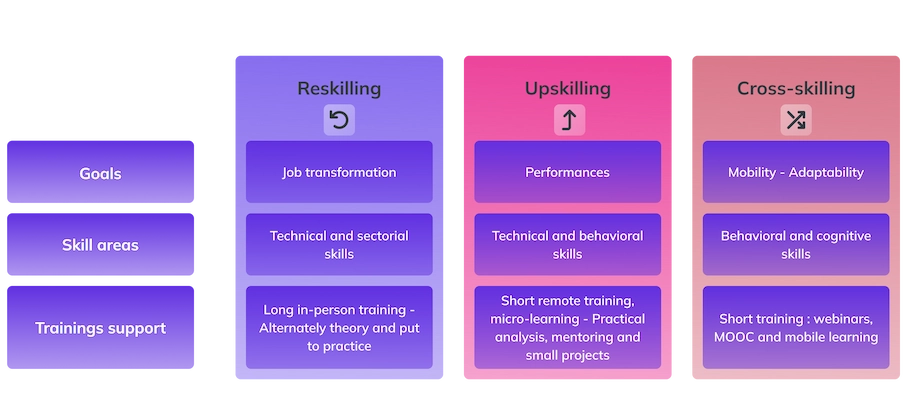
We detail this approach in the article"Skill categories and HR development”.
Rely on a skills map
Defining training budgets involves several dimensions:
- Priority skills to be integrated into the organization
- The impact of legal changes on each profession
- Gaps between required and achieved levels
- Individual aspirations
A skills map is the best way to optimize your budget by visualizing existing capabilities and rationalizing investments.
Here is the Guide to Mapping Skills available for free download.
What methods are used to develop skills?
New development tools have emerged, such as gamification, micro-learning, the metaverse, and social learning. To be effective, these methods must combine two dimensions:
- Adapt to the learning channels preferred by the individual.
- Multiply touchpoints to truly build habits.
Additional resources: