


The combination of HR and managers is at the heart of all talent policies. On paper, their complementarity is obvious: HR structures, managers embody. But in practice, this collaboration is still too often perceived as imperfect, unequal or incomplete.
This is what our survey conducted in June 2025 among 76 professionals (55 HR and 21 managers) reveals, with blunt results: collaboration deemed “correct but perfect”, roles that are sometimes unclear, and priorities that do not always coincide. But behind these differences, a common will is emerging: better understand, better cooperate, better align efforts.
Rather than opposing or pointing fingers, this article proposes to make a constructive diagnosis on current practices, weak signals that should not be overlooked, and the conditions to make this tandem a real lever for talent development.
A collaboration considered generally satisfactory... but not yet smooth
The first results of our survey, conducted between 4 and 23 June 2025 with 76 respondents (21 managers and 55 HR), suggest a rather encouraging basis for collaboration. To the question “How satisfied are you with the current collaboration with your HR/manager partner? ”, HR gives an average score of 7.1/10, against 6,7/10 on the managers side.

Relatively similar scores, which reflect a shared desire to do well and a fairly healthy relationship base. However, collaboration is still too often guided by operational emergencies or mandatory processes, rather than by a fluid and proactive dynamic.
The rest of the survey shows that while the agreement exists, priorities diverge, roles are unclear, and exchanges on skills are still marginal. These are all options that we will explore in the next sections.
Our article to get some answers: How to support managers in the face of their new challenges?
Priorities that do not always coincide
Although HR and managers agree on the importance of collaboration, their exchanges focus on topics... which are not always the same.
The survey conducted in June 2025 with 76 respondents (55 HR and 21 managers) highlights significant differences in the priorities addressed.
How do HR and managerial priorities differ?
- The managers focus their exchanges with HR on daily operational management And the recruitment, followed by the performance.
- The HR, for their part, favor the skills development And the sanity, relegating the recruitment in last position.
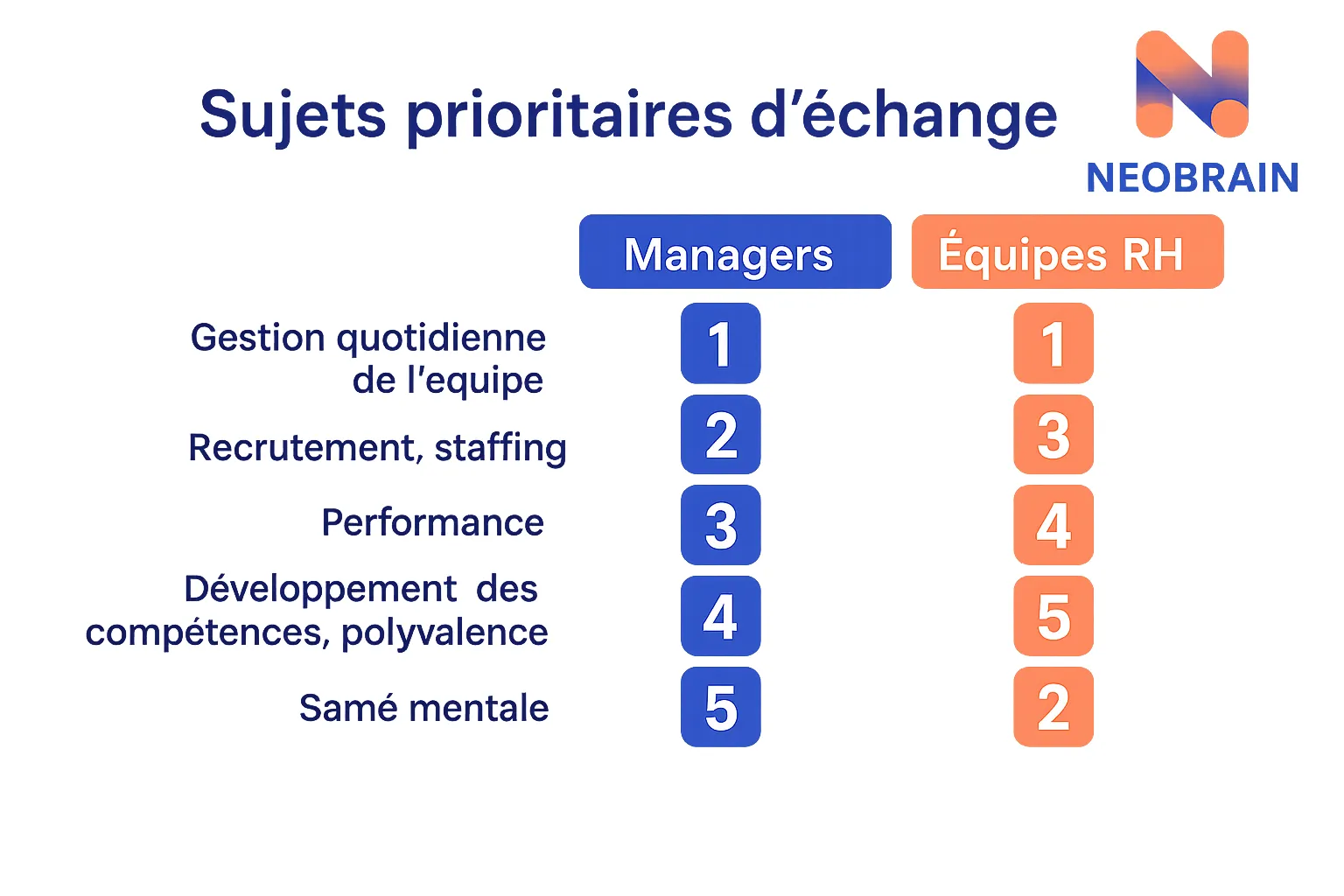
What do these differences in priorities between HR and Managers reflect?
These differences are not a result of a conflictual misalignment, but rather a natural divergence of roles:
- The manager acts on the Short-term, often in an emergency, to meet immediate staffing or performance needs.
- HR has a vision more strategic and preventive, focused on the sustainable development of skills, mobility and well-being.
Our article for delve deeper into the question of the recruitment/internal mobility dilemma: External recruitment: why should it be arbitrated?
Responsibilities are still unclear on some key subjects
Even if HR and managers collaborate constructively overall, a persistent misunderstanding is rarely addressed head-on: Who does what, and how far?
A distribution of roles considered unclear
When asked about the clarity of responsibilities in talent management, survey respondents gave an average score of:
- 3.4/10 HR side
- 3.1/10 Managers side

A low and fairly aligned score between the two audiences, which testifies It's less of a disagreement than a shared uncertainty. It's not so much that you contradict yourself, but that you don't always know what the other person expects — or assumes.
What are the clearly established scopes of responsibilities between HR and Managers?
It's not all a blur. Some responsibilities appear more readable in organizations:
- Commitment and retention : thanks to internal surveys (barometers, eNPs, etc.), HR makes a diagnosis, often co-constructed with managers via action plans.
- Performance evaluation : the annual maintenance processes are well integrated, even if their development dimension (and their regularity) still need to be strengthened.
What are the gray areas that remain between HR and Managers?
Other activities remain, often shared... without explicit coordination :
- Talent identification : between feedback and global strategy, who has the last word?
- Internal mobility : HR who create bridges, managers who don't want to “lose” talent.
- Management and skills development : HR systems are often in place, but managerial feedback is uneven, or even absent.
- Recruiting : an emblematic case of lag. HR reasons in equity and quality, managers in operational urgency. Hence tensions around the use of the service, sometimes decided outside the HR perimeter (via purchases).
Our article to answer it: Responsibilities and pressures at work: how to better distribute tasks
Skills Management: an underlying subject, but not very formalized in exchanges
If we ask HR and managers about the importance of skills in their exchanges, the answers suggest that they are well taken into account: 3.3/5 on the HR side and 3.7/5 on the manager side. But on closer inspection, this theme often remains diffuse, addressed implicitly rather than through formalized rituals.

One figure in particular is striking: 18% of respondents say they never formally assess skills of their collaborators. An even greater proportion if we include evaluations that are only occasional (1 to 2 times per year), which are the majority today. Conversely, only 22% say they do it on a quarterly basis.
Our article to go further : discover our guide to skills management, with concrete examples of evaluation methods adapted to the needs of the field.
Towards a continuous dynamic? A wish more than a reality
What do the results of the survey tell us about the transition to continuous talent management?
The majority of respondents indicate that skills are assessed on an ad hoc basis, during fixed formal moments: annual interviews, sometimes semi-annually.
42% of HR professionals recognize that they have not yet initiated a process towards continuous evaluation, although they perceive its relevance.
Only 26% say they have initiated such a change, while 32% are considering it. Figures that demonstrate an intention... but still little translated into reality.
This data echoes that of the previous section: even when skills are considered important, they often remain disconnected from daily life, in a model that is still very sequenced.

What is holding back this transition to a continuous dynamic?
- The lack of tools to catch weak signals throughout the year
- The lack of time identified to provide regular feedback
- A corporate culture still rooted in fixed HR times
- And sometimes, a difficulty in translating field observations into usable data
What if we rethought the rhythms?
Creating shorter and more frequent evaluation formats, integrating evaluation into team rituals, exploiting hot feedback tools... so many ways to make evaluation more lively and connected to the reality of employees.
Our article to go further: discover the levers of a dynamic approach to skills management on our dedicated page.
The field speaks: simple ideas, rooted in everyday life
What if the best areas for improvement came... from those who experience HR—manager collaboration on a daily basis?
In the survey conducted among 76 HR professionals and managers between 4 and 23 June, an open question invited everyone to propose a priority action to strengthen collaboration. What emerged was a common point: the desire to progress through concrete, simple, but structuring actions.
- “Go more out in the field to meet employees”
- “Set up monthly categorized reviews: administrative, skills, etc.”
- “Making the management culture evolve”
- “Have more complete HR software”
- “More communication and transparency”
These answers draw a clear line: the need for vicinity, of dialogue frameworks, andadapted tools to get out of a collaboration perceived as too administrative or fragmented.
And now?
Implementing a smoother dynamic is not based on a big transformation plan. It often starts with modest adjustments, but regular:
- Establish a monthly HR—manager point
- Clarifying responsibility on a subject that has remained unclear
- Testing a feedback grid in a work situation
- Formalize good reflexes in a shared mini-kit
To anchor these initiatives in the long term, key moments such as annual interviews can become synchronization highlights.
Article to discover how to make it a convergence lever: Succeed in your annual maintenance campaign


