63% of employers identify the skills gap as the primary barrier to transformation (WEF, Future of Jobs 2025). Yet the annual review—the most common HR touchpoint—remains largely focused on past performance and goals for the year ahead. At a time when AI is transforming roles faster than job descriptions can be updated, this very moment—the review—can become the most reliable sensor for an organization's actual skills. Provided you know what to do with it.
L'essentiel à retenir
- 63% des employeurs identifient le skills gap comme principal frein à la transformation (WEF, Future of Jobs 2025) — l'entretien annuel est le capteur le plus sous-exploité pour le mesurer.
- Sans référentiel de compétences commun, les données recueillies en entretien sont hétérogènes et non consolidables à l'échelle de l'organisation.
- L'évaluation doit s'appuyer sur des faits observables, pas sur des impressions managériales — c'est la condition pour que les données soient fiables et comparables.
- L'entretien annuel est le seul moment structuré pour mesurer le ROI réel de la formation : comparer le niveau observé avant et après une action de développement.
- Un Plan de Développement des Compétences ancré dans les niveaux réels mesurés en entretien est plus efficace — et plus défendable en CODIR — qu'un PDC construit sur des estimations managériales.
- La vraie valeur de la connexion entretiens/compétences est organisationnelle : alimenter une cartographie vivante, identifier les zones à risque et piloter la mobilité interne à l'échelle.
- Le bon indicateur : le taux de compétences évaluées ayant donné lieu à une action réalisée — pas le taux d'entretiens menés.
Key takeaways
- 63% of employers identify the skills gap as the main barrier to transformation (WEF, Future of Jobs 2025) — the annual review is the most underused tool to measure it.
- Without a shared skills framework, data collected in performance reviews is heterogeneous and impossible to consolidate at organizational scale.
- Assessment must be based on observable facts, not managerial impressions — that's the condition for reliable, comparable data.
- The annual review is the only structured moment to measure the real ROI of training: comparing skill levels before and after a development action.
- A Skills Development Plan grounded in actual levels measured during reviews is more effective — and more defensible in executive committees — than one built on managerial estimates.
- The real value of connecting reviews to skills management is organizational: feeding a living skills map, identifying risk areas, and driving internal mobility at scale.
- The right metric: the share of assessed skills that led to a completed action — not the number of reviews conducted.
Why the annual review alone isn't enough
In most large organizations, annual reviews and skills management coexist without truly communicating. One produces a report. The other maintains a database. Both remain silos.
The result is predictable: data collected during reviews does not feed into the skills map. The gaps identified do not systematically lead to action. And the skills framework, built independently, fails to reflect what managers actually observe on the ground.
Connecting the two isn't a matter of tools. It's a matter of method — and the order in which you do things.
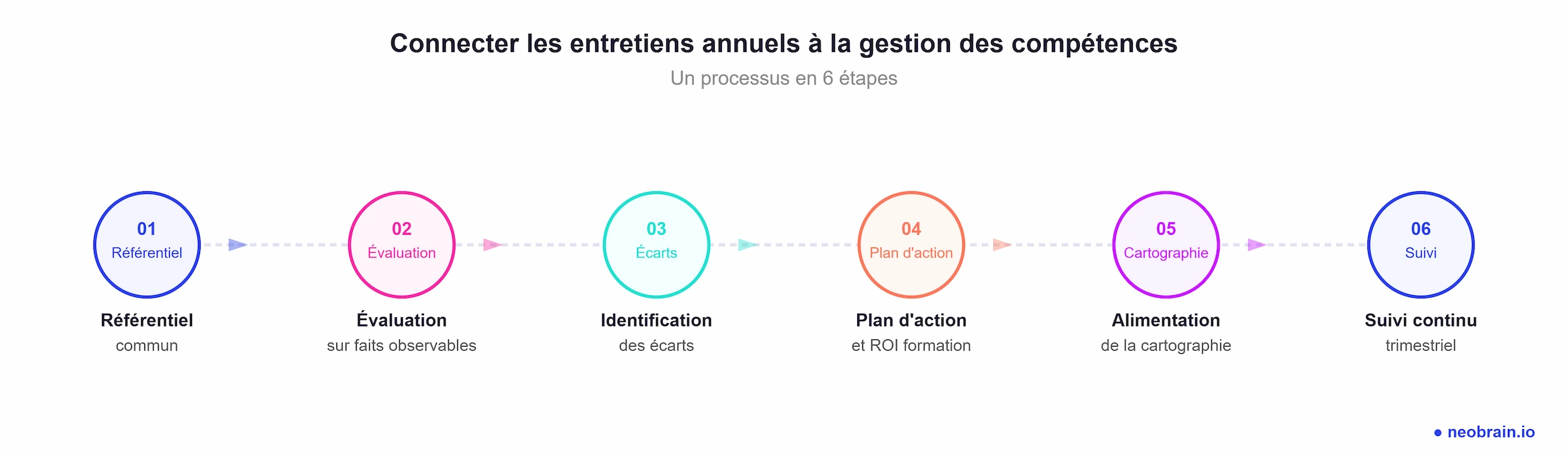
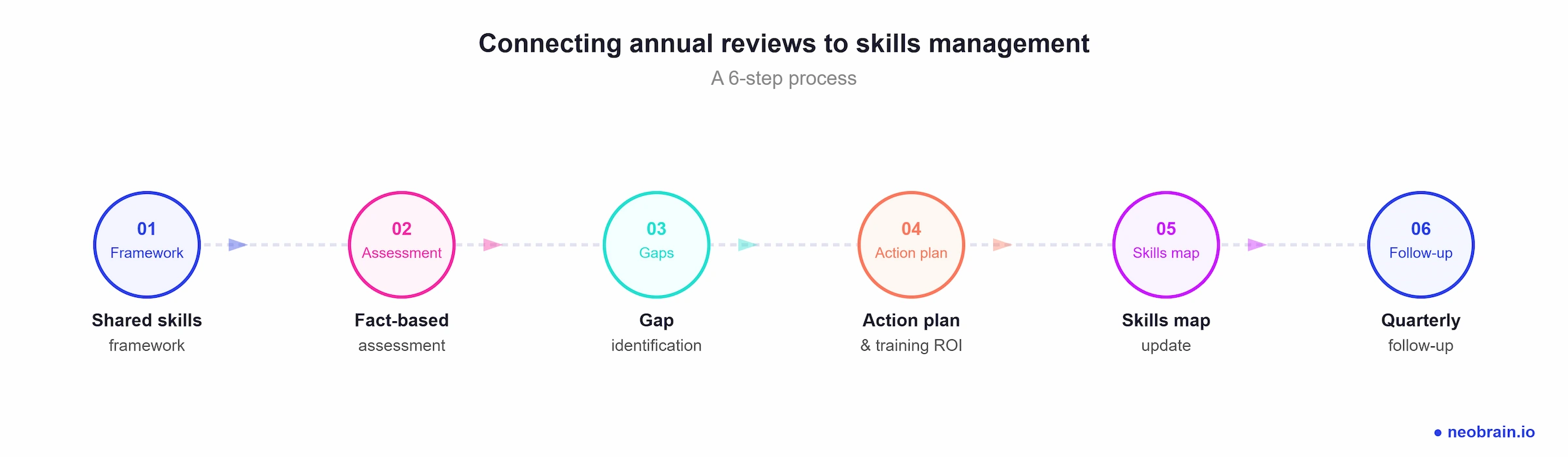
Les 6 étapes : référentiel commun → évaluation sur faits observables → identification des écarts → plan d'action et ROI formation → alimentation de la cartographie → suivi trimestriel.
The 6 steps: shared framework → fact-based assessment → gap identification → action plan and training ROI → skills map update → continuous quarterly follow-up.
Start with a common skills framework
It is impossible to assess skills during a review if the company hasn't first defined what it means by "skill" for each role.
An operational framework—not a 400-line catalog—must specify for each job family:
- The different skill categories expected
- The level required to hold the position (from "in acquisition" to "expert")
- The strategic skills for the next 2-3 years
The test of a good framework: a manager can use it in a review without prior training. If that's not the case, it's too complex.
This foundation is what makes annual reviews comparable from one employee to another, one team to another, and one site to another. Without it, every review produces heterogeneous data that no one can consolidate. If you are at the pivotal moment of creating or revising your framework, here is How to create a skills framework .
Assessing skills during the review: method and structure
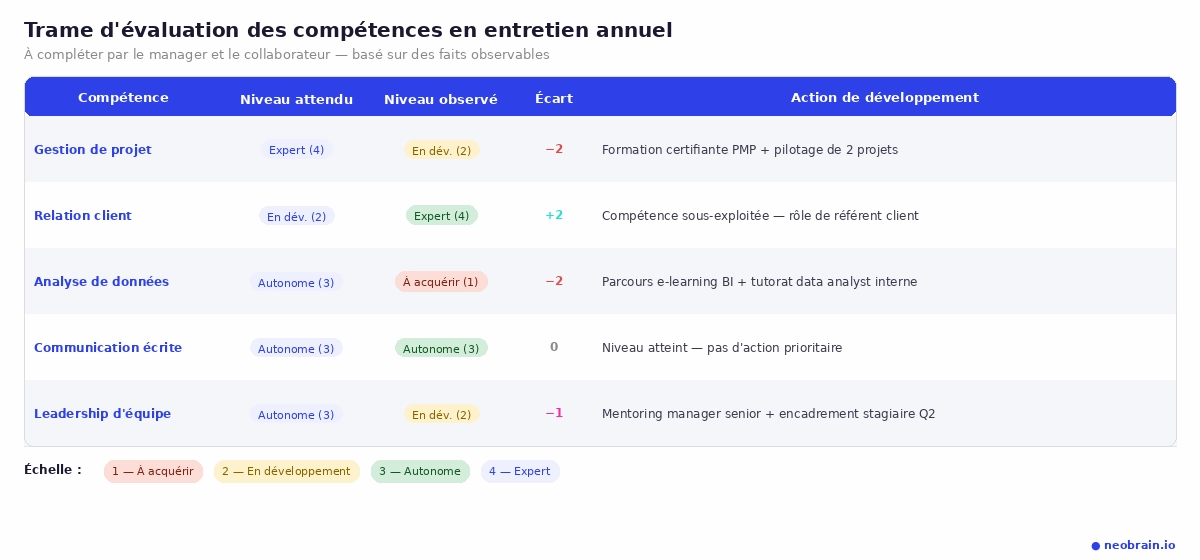
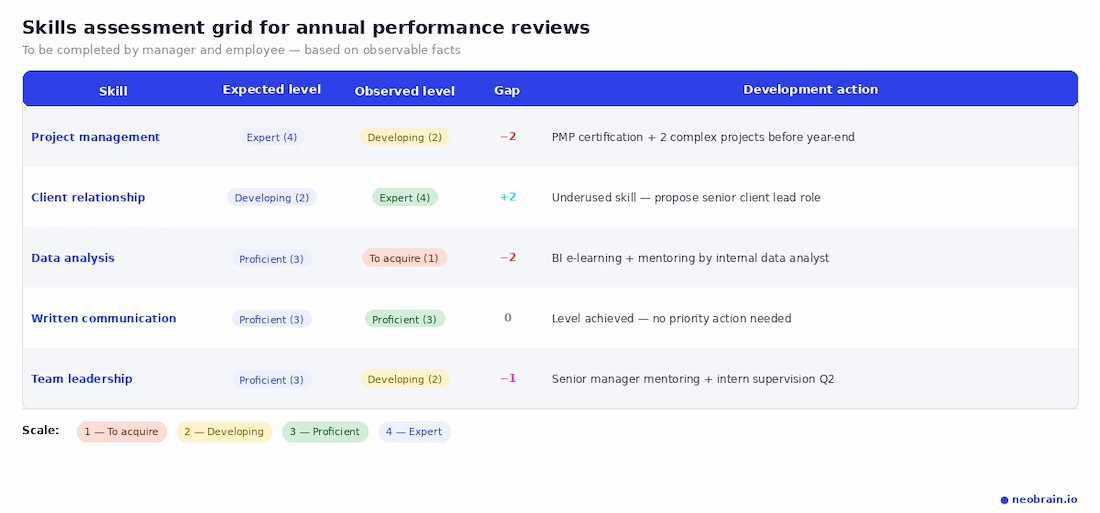
Échelle : 1 — À acquérir · 2 — En développement · 3 — Autonome · 4 — Expert
Scale: 1 — To acquire · 2 — Developing · 3 — Proficient · 4 — Expert
Self-assessment first
Asking employees to assess their own skills before the review has two effects: they arrive prepared, and the exchange becomes a dialogue rather than a top-down judgment. The gap between self-assessment and managerial assessment is often the most useful signal — it reveals blind spots on both sides.
Rely on observable facts
Every skill level assessed must be based on tangible elements: a situation, a project, an observable behavior, a result. "Good project management" is meaningless. "Delivered project X on time despite a 20% reduction in resources" is citable, trackable, and comparable.
Distinguish between four dimensions
- Skills actually used in the current role
- Skills to be developed to perform the role with excellence
- Skills required for a planned career move
- Skills the employee personally wishes to develop
This distinction avoids confusion between current performance and future potential — one of the most frequent pitfalls in annual reviews.
If you are looking to structure how you conduct your annual reviews — structure, legal framework, management best practices — our complete guide to the annual performance review details every step.
Turn every gap into an action plan — and measure training ROI
This is the step that most organizations rush — and it is where a significant part of their training investment ROI is determined.
In France, companies spend on average 3.5 to 3.7% of their payroll on professional training, which represents a budget of approximately €1,500 to €2,000 per employee per year in organizations that provide structured training (Céreq, DARES, 2024–2025). If the only indicator available after a training session is the participant's immediate satisfaction, no one can answer the question: did this training actually lead to a real increase in skills?
The annual review is the only structured moment where you can compare the level observed before and after a development initiative. It is what transforms training into a measurable investment—rather than an unjustifiable budget line item.
In practical terms, every identified gap must lead to a specific action:
- Training, tutoring, mentoring, on-the-job experience, cross-functional assignments, certification
- With a designated manager, a deadline, and a measurable success criterion
Example of how to phrase a skill development goal:
- Objective : reach an autonomous level in project management by December.
- Action : complete a two-day training course, lead a low-complexity project, and have two follow-up meetings with a senior project manager.
- Criterion : project delivered on time with a satisfaction rate of over 80%.
We recommend following the rule of having no more than two or three priorities. An action plan with ten skills to develop is an action plan that is unlikely to be followed.
Updating the skills map and building a training plan rooted in reality
This is the step that most organizations miss—and it is precisely where the connection between reviews and skills generates the most strategic value.
A training or skills development manager can build a Skills Development Plan (SDP) based on the critical skills identified with managers and the Executive Committee. That is a good foundation. However, this SDP will be far more effective—and much easier to justify to the Executive Committee—if it is built upon the actual proficiency levels observed during performance reviews.
What is the difference between an SDP built in a vacuum and one rooted in data?
- The former relies on what managers think their teams can do
- The latter relies on what performance reviews have actually measured, skill by skill, employee by employee
Successfully aggregating this information from the individual level to the organizational level helps address many other challenges:
- Which critical skills are concentrated in only one or two people?
- Where are the most significant gaps between future needs and current resources?
- Which employees have the necessary skills for internal mobility—including those who haven't explicitly asked for it?
- Which training programs have actually produced measurable skill growth?
This is the logic that Lexi, Neobrain's AI agent, implements: by cross-referencing performance review data with the job competency framework and existing HRIS data, it produces a consolidated skills map for the entire organization—directly fueling the SDP with reliable data rather than managerial estimates. Discover how Neobrain connects performance reviews with skills mapping
Next step: ensuring continuity between reviews
The annual review defines the trajectory. It cannot steer it alone.
Quarterly or semi-annual check-ins allow you to track progress, adjust actions, and gather new factual information before the next assessment. Without this follow-up, the action plan created during a review remains just an intention—formalized, validated, and then forgotten.
The right success metric is not the completion rate of reviews. It is the percentage of evaluated skills that led to an action, and the completion rate of those actions within the scheduled timeframe.
Questions fréquentes
Comment connecter les entretiens annuels à la gestion des compétences ?+
La connexion repose sur six étapes : partir d'un référentiel commun, évaluer les compétences sur des faits observables, identifier les écarts, construire un plan d'action avec des critères mesurables, alimenter la cartographie organisationnelle avec les données recueillies, et assurer un suivi trimestriel. Sans référentiel préalable et sans remontée des données dans les outils RH, l'entretien produit des informations individuelles qui ne servent jamais la stratégie compétences de l'entreprise.
Comment mesurer le ROI d'une formation grâce à l'entretien annuel ?+
L'entretien annuel est le seul moment structuré pour comparer le niveau de compétence d'un collaborateur avant et après une action de formation. En évaluant les compétences ciblées par la formation lors du bilan suivant, et en s'appuyant sur des faits observables, il devient possible de mesurer si la montée en compétences a réellement eu lieu — et d'ajuster le plan de développement en conséquence.
Quelle est la différence entre l'entretien annuel et l'entretien professionnel ?+
L'entretien annuel d'évaluation est centré sur la performance de l'année écoulée, les compétences mobilisées et les objectifs à venir. L'entretien de parcours professionnel — qui a remplacé l'entretien professionnel — est centré sur l'évolution à long terme du collaborateur, ses aspirations et ses perspectives de développement. Les deux sont complémentaires mais doivent rester distincts dans leur objectif et leur compte-rendu.
Comment construire un Plan de Développement des Compétences à partir des entretiens ?+
Un PDC efficace croise deux sources : les compétences critiques identifiées avec les managers et le CODIR, et les niveaux réels mesurés en entretien. Sans cette confrontation, le PDC repose sur des estimations. Avec elle, il reflète les vrais écarts entre les besoins de l'organisation et les capacités disponibles — ce qui le rend plus ciblé, plus défendable et plus facile à prioriser.
Quels outils permettent de connecter entretiens et gestion des compétences à grande échelle ?+
Un SIRH intégré ou une plateforme de gestion des talents peut relier directement les données d'entretien au référentiel de compétences. Pour les grandes organisations, des solutions spécialisées comme Neobrain permettent de croiser les évaluations individuelles avec les données SIRH existantes pour produire une cartographie consolidée — et alimenter automatiquement le plan de développement des compétences sans ressaisie manuelle.
Frequently asked questions
How do you connect annual performance reviews to skills management?+
The connection relies on six steps: starting from a shared skills framework, assessing competencies based on observable facts, identifying gaps, building an action plan with measurable criteria, feeding the organizational skills map with collected data, and ensuring quarterly follow-up. Without a prior framework and without data flowing into HR tools, reviews produce individual insights that never serve the organization's skills strategy.
How can annual reviews be used to measure training ROI?+
The annual review is the only structured moment to compare a employee's skill level before and after a training action. By assessing the competencies targeted by the training in the following review — based on observable facts — it becomes possible to measure whether upskilling actually occurred and adjust the development plan accordingly.
What is the difference between an annual performance review and a professional development review?+
The annual performance review focuses on the past year's performance, skills used, and upcoming objectives. The professional development review focuses on the employee's long-term career path, aspirations, and development prospects. Both are complementary but must remain distinct in purpose and documentation.
How do you build a Skills Development Plan from performance review data?+
An effective Skills Development Plan crosses two sources: critical competencies identified with managers and the executive committee, and actual skill levels measured during reviews. Without this cross-referencing, the plan relies on estimates. With it, it reflects real gaps between organizational needs and available capabilities — making it more targeted, defensible and easier to prioritize.
What tools connect performance reviews to skills management at scale?+
An integrated HRIS or talent management platform can directly link review data to the skills framework. For large organizations, specialized solutions like Neobrain cross individual assessments with existing HRIS data to produce a consolidated skills map — automatically feeding the Skills Development Plan without manual re-entry.