
Professional careers now occupy a central place in HR issues. In a context of tensions over recruitment, the accelerated transformation of jobs and the growing impact of AI, Businesses can no longer be content with static career management.
The attractiveness and retention of talent are increasingly based on the ability to offer clear, credible career prospects that are adapted to the realities of work. This means going beyond a reading based strictly on the positions occupied, for Reasoning in terms of skills And of Bridges between professions.
Professional career: definition
A simple and useful definition for HR
From the point of view of the company, the professional career corresponds to all of experiences lived by an employee, of skills that it mobilizes and develops, as well as transitions that it operates over time. It is built through the positions occupied, but also through transversal projects, internal mobility, training, responsibilities or even changes in scope.
Contrary to a strictly administrative reading, professional career is therefore not limited to a succession of functions or titles. It reflects a dynamic of continuous learning, shaped by the needs of the organization, the transformations of professions and individual aspirations.
For HR teams, this approach allows them to better understand How value is created over time, by identifying the skills that are really mobilized and transferable, beyond job titles.
Career path vs career: understanding the nuance
The career generally refers to a statutory progression (level, title, responsibility), often thought of vertically.
The professional career path describes a more dynamic trajectory : experiences, skills mobilized, transitions, mobilities and learning, including transversal or through hybrid roles.
For HR teams, this nuance is changing the way they manage mobility and development: we no longer only manage positions, we orchestrate bridges between the organization's jobs.
The main logics of professional career today
Career paths no longer follow a single model. Under the effect of the transformations of professions and the expectations of employees, The trajectories are diversifying. For HR teams, the challenge is to understand these different logics in order to better support mobilities and developments.

Traditional routes
Traditional routes are based on vertical progression. The employee evolves in a business sector, with successive job changes marked by an increase in responsibility or a change in hierarchical level.
This model remains common in structured organizations, but it now coexists with more open and less linear trajectories.
Enriched and transversal courses
Enriched and transversal courses translate a more horizontal evolution. The employee broadens his field of action by changing function, by participating in transversal projects or by developing new expertise.
These trajectories make it possible to strengthen transferable skills and to create bridges between professions, without necessarily following a logic of vertical promotion.
Entrepreneurial and hybrid paths
Entrepreneurial careers are increasingly becoming an option for retraining or extending a career, in particular through advice or coaching. In France, more than 1.11 million businesses were created in 2024, of which around 716,000 micro-enterprises, or nearly two thirds of creations.
These trajectories illustrate a growing porosity between employment and independence, especially for experienced profiles, including in HR functions.
Nomad itineraries or “cherry pickers”
Nomad journeys are characterized by a succession of experiences chosen for their content, impact or learning value. This logic is particularly pronounced among young workers.
According to INSEE, In Île-de-France, around one employee out of five changes jobs in one year, with significantly greater mobility among young people than among their elders. These trajectories are forcing businesses to rethink engagement and retention beyond traditional patterns.
Why are paths becoming less linear
Professional careers are changing rapidly under the effect of several profound transformations. Where trajectories have historically followed relatively predictable paths, Businesses now have to deal with more frequent mobilities, skills that are being recomposed and jobs that are changing.
Jobs are changing faster than organizations
Skills needs are changing more rapidly than organizational structures today. New roles are emerging, others are being recomposed, while the boundaries between professions become more permeable. In this context, career paths can no longer be thought of only as fixed trajectories within a sector.
As summarized by a human resources director interviewed as part of recent work with Capgemini Invent on career paths :
The main obstacle to internal mobility is not the lack of desire on the part of employees, but our collective inability to make the skills that are really available in the organization legible.
This lack of visibility limits the ability of companies to activate existing bridges between businesses.
Artificial intelligence recomposes skills
Artificial intelligence accelerates this dynamic by transforming work content. It automates certain tasks, enriches others and brings out new needs for expertise, analysis or human interaction. This evolution does not eliminate jobs, but Recompose skills who constitute them.
Another HR director highlights as follows:
AI does not make paths disappear, it extends them. Above all, it requires thinking other than by job titles.
For HR, this reinforces the need to think in terms of transferable skills and business proximity, in order to secure professional transitions.
Internal mobility is becoming a strategic lever
In a context of tensions over external recruitment, internal mobility is emerging as a structuring lever. It is no longer just about loyalty, but becomes a way to orchestrate the continuous redeployment of know-how within the company.
Some organizations that have initiated this transformation share a strong conviction:
Mobility is not just another HR process. It is a cultural choice, which involves managers, employees and management at the same time.
This change in posture makes it possible to go beyond a logic of talent retention in favor of a logic of belonging to the organization as a whole.
How to take stock of a professional career?
Taking stock of a career path is no longer about rereading a series of job titles. Rather, the challenge is to identify what really structures a trajectory: the skills mobilized, the successful transitions, the aspirations and the margins for evolution. For HR as well as for employees, this report becomes a projection tool, not an administrative exercise.
When should you review your professional career?
The assessment of a professional career is not limited to a formal appointment every two or three years. It gains in value when it is included in the Key times in professional life.
In particular, it can be carried out:
- During professional interviews and, tomorrow, as part of thecareer interview, designed to structure trajectories over time;
- On the occasion of a change of role, profession or scope ;
- After a structuring experience (transversal project, mobility, return from a long vacation);
- in a logic of preparation for internal mobility or changes in the medium term.
These moments are natural anchors for engaging in a useful dialogue that focuses on skills and perspectives, rather than simply looking back on past performance.
Learn more about Professional career interview.
Clarifying your aspirations and criteria (what really matters)
A coherent journey is not only built by “climbing” or by changing functions. It is built on the basis of explicit criteria : level of autonomy, type of missions, work environment, desired impact or desired balance.
Without this clarification, mobilities risk being opportunistic... and disappointing.
Identify transferable skills (not just “job”)
The core of a professional career often lies in skills that go beyond a specific role: management, analysis, coordination, customer relationships, change management, ability to structure a project.
It is this Reading by skills — rather than by titles — which opens up bridges to unexpected but accessible jobs.
Identify gaps and obstacles
Professional development rarely fails due to a lack of motivation. They are more often hit by concrete obstacles. : lack of exposure, lack of trust, lack of time to train, poor onboarding, etc...
Identifying these differences makes it possible to transform an intention to evolve into a realistic trajectory.
Seek feedback (peers, managers, mentors, 360°)
A course is rarely built alone. External feedback — manager, colleagues, mentors or 360° feedback devices — makes it possible to Confronting perception that one has from one's skills to the reality observed in the organization.
It is often this cross-examination that triggers the most relevant forms of mobility.
To structure these exchanges over time, discover our complete kit of 10 HR interview frames, designed to support career paths, internal mobility and skills development.

How to support career paths: HR roles and managers?
Supporting a professional career does not consist in piling up HR systems. The challenge is more structural: to create an environment where trajectories become legible, questionable and truly actionable.
In organizations that make progress on the subject, three conditions always come up.
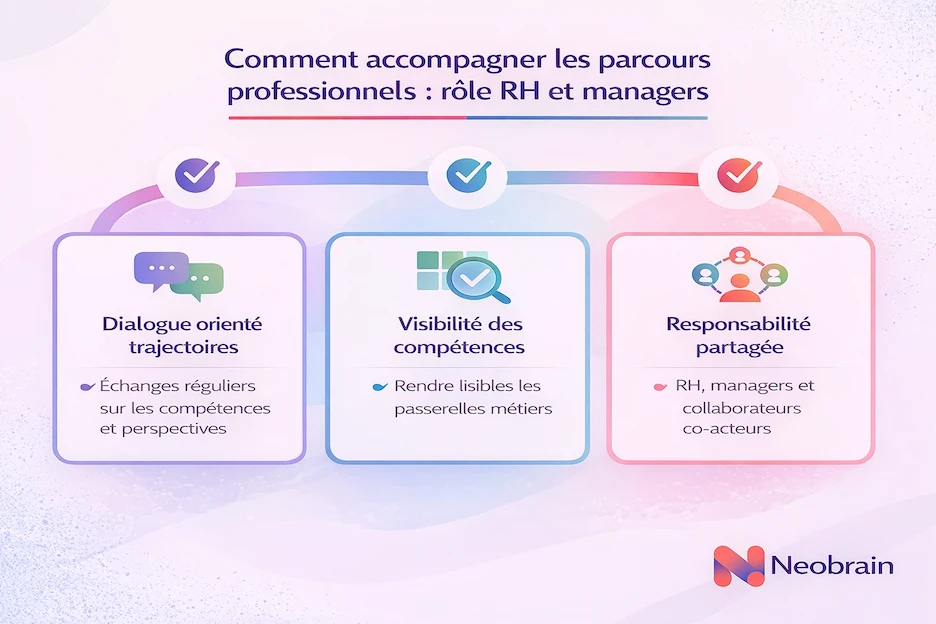
Establishing a dialogue oriented towards trajectories, not just performance
The courses are built over time, through regular exchanges on aspirations, development skills and possible perspectives. This dialogue should not be limited to a formal appointment: it must become a managerial and HR reflex.
Making skills and bridges between jobs visible
Internal mobility rarely fails due to a lack of opportunities. It fails mainly because of a lack of visibility: employees do not know what is accessible, and organizations struggle to identify the proximity between professions.
Some companies structure this visibility through concrete practices, such as Career forums, internal project markets or skills maps to reveal bridges between functions.
Sharing responsibility between HR, managers and employees
A career path cannot be carried out solely by HR, nor can it be based solely on individual initiative. It implies co-responsibility: HR to structure, managers to support, employees to project themselves.
This logic is also reflected in a clear visualization of what is achievable, following a precise support trajectory. This is what the Neobrain Galaxy tool allows in particular.
Video
Then equip at the right level
Once these conditions are met, companies can rely on concrete mechanisms to manage trajectories, accelerate internal mobility and secure transformations.
To go further, discover our dedicated article to career management tools and to internal mobility.
In summary
The professional career is no longer managed as a succession of positions. It is built over time, at the crossroads of skills, aspirations and opportunities offered by the organization.
For HR teams, The challenge is less to multiply the devices than to make the trajectories visible, coherent and activatable, sharing responsibility with managers and collaborators.
In a context of accelerated business transformation, companies that know how to structure these paths will reinforce both their attractiveness, their ability to adapt and the sustainable commitment of talent.
FAQ — Professional background
What is a career path?
The career path corresponds to all the experiences, skills mobilized and transitions that structure the trajectory of an employee over time, within and outside the company. It is not limited to occupied positions.
What is the difference between career and career?
Career most often refers to a statutory or hierarchical progression. The professional career offers a more dynamic reading, integrating mobilities, skills developed and transversal experiences.
Which companies are often cited for their diverse career practices?
Some large companies are regularly mentioned for their internal mobility and skills development policies, such as Thales, Orange or L'Oréal. Other groups such as Danone, Michelin or BNP Paribas are also recognized for the diversity of career paths they offer their employees.
What are the main types of career paths?
In particular, a distinction is made between traditional paths, enriched or transversal paths, entrepreneurial or hybrid paths, as well as nomadic paths, characterized by a succession of targeted experiences.
Why are career paths becoming less linear?
The transformation of jobs, the differentiated impact of artificial intelligence and the tension on recruitment are forcing companies to rethink trajectories beyond traditional sectors.
What is the role of HR in supporting career paths?
HR plays a key role in making skills visible, structuring bridges between professions and establishing co-responsibility with managers and employees in the construction of trajectories.
When to take stock of a professional career?
The assessment of a career path can be carried out during professional interviews, during a mobility, after a structuring project or in order to prepare for internal development.
How to promote internal mobility without disorganizing teams?
Internal mobility is based on the visibility of skills, clear rules and continuous dialogue. It also implies a sharing of responsibility between HR, managers and employees.
What tools make it possible to structure career paths?
In particular, companies rely on exchange mechanisms, skills frameworks and career management solutions to manage trajectories and internal mobility.